
Trimble’s Q3 Results Suggest Its Subscription Transition Is Working But Hardware Still Matters

Trimble’s third-quarter results show a business benefiting from recurring software revenue while retaining significant exposure to physical equipment and construction-market conditions.
Revenue reached $966.8 million, up 7% year over year on both a reported and organic basis. Annualised recurring revenue increased 11% to a record $2.56 billion, including 10% organic growth.
Adjusted EBITDA was $278.5 million, equivalent to a 28.8% margin. GAAP net income was $59.1 million, while non-GAAP net income was $200.5 million. Trimble also repurchased approximately four million shares for $231.7 million. These figures have been checked against Trimble’s official third-quarter release, rather than the garbled secondary summary.
Subscriptions now provide the majority of quarterly revenue
Subscription and services revenue was $642.5 million, or approximately 66.5% of total revenue. Product revenue supplied the remaining $324.3 million.
This mix supports Trimble’s long-running transition from selling positioning instruments and licenses towards connected workflows with recurring payments. The 11% increase in annualised recurring revenue also outpaced the company’s 7% revenue growth.
ARR is not the same as recognised revenue, however. It annualises the current value of subscription, support and term-license arrangements. It should be treated as an indicator of the recurring contract base, not added to reported revenue.
Growth varied across the portfolio
Architecture, engineering, construction and operations (or AECO) was Trimble’s strongest major segment. Revenue increased from $358.5 million to $395 million, while its operating margin improved from 31.8% to 33.5%.
Field Systems revenue rose from $408.7 million to $435.8 million, but its operating margin fell from 33.4% to 29.5%. Transportation and Logistics grew only modestly, from $134 million to $136 million.
The figures suggest that construction software and connected project workflows are scaling well, while hardware-heavy field operations face a more complicated mix of costs and demand.
They also make it difficult to attribute the quarter specifically to artificial intelligence. AI features may improve product adoption and retention, but Trimble does not disclose a separate AI revenue line. The financial evidence supports the subscription strategy more directly than it supports a distinct AI-growth claim.
How Trimble compares with Hexagon
Hexagon reported 13% organic growth in its third quarter, but growth in its Infrastructure & Geospatial division was only 4%. Hexagon’s recurring revenue grew 3% organically, compared with Trimble’s 10% organic ARR growth. Conversely, Hexagon’s sensor and robotics portfolio grew 20%, demonstrating stronger momentum in physical measurement systems. Hexagon’s third-quarter report provides the benchmark.
The companies define recurring revenue and adjusted profitability differently, so their percentages are not directly interchangeable. Directionally, however, Trimble appears stronger in expanding its recurring contract base, while Hexagon’s fastest growth is coming from sensors, positioning and autonomy.
Guidance points to a strong finish
Trimble expects full-year revenue of $3.91-3.94 billion and non-GAAP earnings of $3.63–3.69 per share. Its fourth-quarter revenue forecast of $1.031–1.061 billion implies a step up from Q3.
The company simultaneously forecasts a full-year GAAP loss, reflecting accounting items including impairment effects, even though its underlying operations remain profitable. That gap is a reminder to examine both statutory and adjusted results.
Trimble’s quarter does not mean hardware has become secondary. Rather, it suggests the company is successfully using its installed base of positioning, surveying and construction technology to build a higher-margin layer of subscriptions and connected services around the physical tools.



#Business
Next article
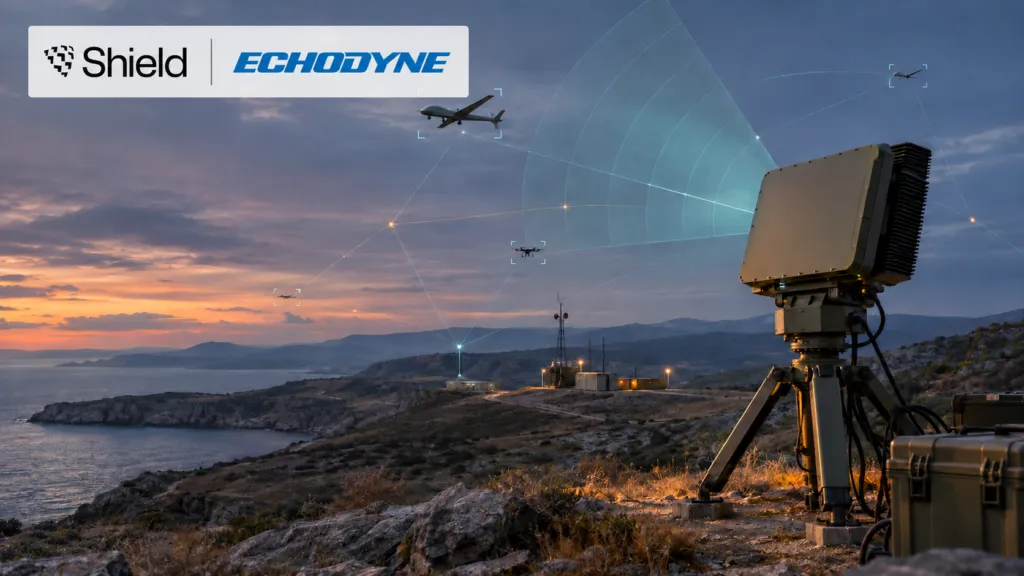
Shield AI’s proposed $5.3 billion acquisition of Echodyne is not merely a defence-sector consolidation. It is a statement about where value is migrating within autonomous systems.
Artificial intelligence may make decisions, but autonomy remains constrained by what a system can detect, track and classify. By acquiring a compact-radar specialist, Shield is moving down the technology stack and securing greater control over the sensor inputs used by autonomous aircraft and counter-drone systems.
The strategic rationale is straightforward. The valuation is more difficult to explain.
What has been agreed
Under the definitive agreement, Shield will pay $4.8 billion at closing, with up to $500 million in additional consideration linked to performance. Closing is expected in early 2027, subject to regulatory approvals.
Shield is simultaneously raising $2.5 billion. This consists of a $1 billion Series H round at a $28.8 billion post-money valuation, $1 billion in structured equity from Blackstone-managed funds and $500 million in debt led by JPMorgan.
The financing mix matters. The headline valuation is not supported exclusively by conventional venture equity. Structured capital and debt introduce different repayment, return and risk characteristics.
The Echodyne purchase price represents approximately 18% of Shield’s stated post-money valuation. Neither company disclosed enough financial information to calculate a reliable revenue or earnings multiple.
A striking industry benchmark
One useful comparison is Axon’s acquisition of counter-drone company Dedrone. Axon’s annual filing valued the acquired 79.8% stake at approximately $391 million and its existing interest at $112 million, implying a total fair value of about $503 million.
Shield’s maximum Echodyne consideration is therefore about 10.5 times that amount.
This is not a like-for-like comparison. Dedrone is primarily associated with airspace awareness, software and counter-drone integration, while Echodyne owns a radar technology and manufacturing platform with broader applications. Even so, the gap demonstrates the premium Shield is placing on proprietary sensing hardware.
Shield’s $28.8 billion valuation also equals roughly 47% of Anduril’s reported $61 billion valuation following its $5 billion Series H. Anduril has followed a similar integration strategy, acquiring technologies across sensors, command systems and effectors.
The industry direction is clear: leading defence-technology platforms increasingly want to control the entire detect, decide and act chain.
What Echodyne contributes
Echodyne’s electronically scanned array radars use its proprietary MESA architecture. The company says its systems are deployed across hundreds of security and counter-drone installations in more than 40 countries.
Its radar products are already integrated with remote weapon stations, lasers, high-power microwave systems and command platforms. The company’s newsroom also shows recent selections involving BAE Systems and Kongsberg, illustrating its position within a broader partner ecosystem.
Shield and Echodyne say they both expect triple-digit revenue growth. That is a forward-looking management claim, and no absolute revenue figures were provided.
Echodyne also received a contract with a ceiling of $250 million from the US military’s JIATF-401. A ceiling defines the maximum potential value, not guaranteed orders or recognised revenue.
Similarly, Echodyne’s new 86,350-square-foot facility is designed to support capacity of approximately 30,000 radars per year. Capacity should not be confused with current output, customer demand or delivered units.
The neutrality problem
The acquisition could improve integration between Echodyne radar and Shield’s Hivemind autonomy software. Tighter sensor-software coordination may reduce latency, improve tracking and support autonomous responses in communications-degraded environments.
But Echodyne’s value also comes from being used by multiple integrators. Those partners must now consider whether a strategically important sensor supplier remains neutral after becoming part of Shield.
Shield says Echodyne will retain its team and continue offering standalone products. The practical test will be whether competing autonomy, command-and-control and counter-drone providers receive equal access to hardware, interfaces, support and product roadmaps.
This is particularly important in defence procurement, where customers increasingly request modular and interoperable systems rather than dependence on a single prime contractor.
A bet that extends beyond defence
Compact radar also has civilian relevance for airports, critical infrastructure, public safety and future uncrewed-aircraft traffic management. Echodyne could give Shield a path into these markets, although defence integration is clearly the deal’s immediate centre of gravity.
Fresh independent LinkedIn and Reddit analysis of the exact transaction remains sparse. Most early amplification has come from the companies, investors and defence-technology community. The more useful industry debate concerns open integration, manufacturing scale and whether large contract ceilings become repeatable orders.
Shield is paying a substantial premium to own a critical part of the autonomy stack. The acquisition will look prescient if Echodyne becomes a widely adopted sensing standard while maintaining its partner ecosystem. It will look far more expensive if integration narrows that ecosystem or if projected production and revenue growth fail to materialise.


