

Electric utilities do not only have a shortage of wires, transformers and substations. They also have a visibility problem.
That is the opportunity behind Gridsight, an Australian grid-software company that has raised a $26 million Series B led by Insight Partners. Galvanize joined existing investors Airtree, Energy Transition Ventures and Aera VC. The company plans to use the funding to expand in the United States while continuing to grow in Australia.
Gridsight’s argument is simple: electricity networks are often planned around static, conservative assumptions even though available capacity changes by feeder, location, time of day and season. Better data cannot remove every physical constraint, but it can identify where existing infrastructure is being underused and where new investment is genuinely necessary.
For geospatial professionals, this is what makes the company interesting. Gridsight is effectively building a living electrical model from smart-meter data, GIS asset records, SCADA telemetry and information about distributed energy resources such as rooftop solar and batteries. It calls the result a Foundational Grid Model. In practical terms, it is an electrical digital twin designed to answer a spatial and temporal question: how much can this part of the network safely carry right now?
From a map of assets to a model of capacity
Traditional utility GIS tells an operator where poles, conductors, transformers and customers are located and how they are connected. That spatial topology remains essential, but it does not by itself reveal the condition of the network at a particular hour.
Gridsight adds smart-meter observations and electrical modelling to estimate local loads, voltage conditions, distributed generation and constraints. The company says its platform can automate connection screening, run physics-informed annual power-flow studies and calculate dynamic limits for imports or exports.
That distinction matters. A static map describes the grid. A capacity model tries to predict what the grid can safely do.
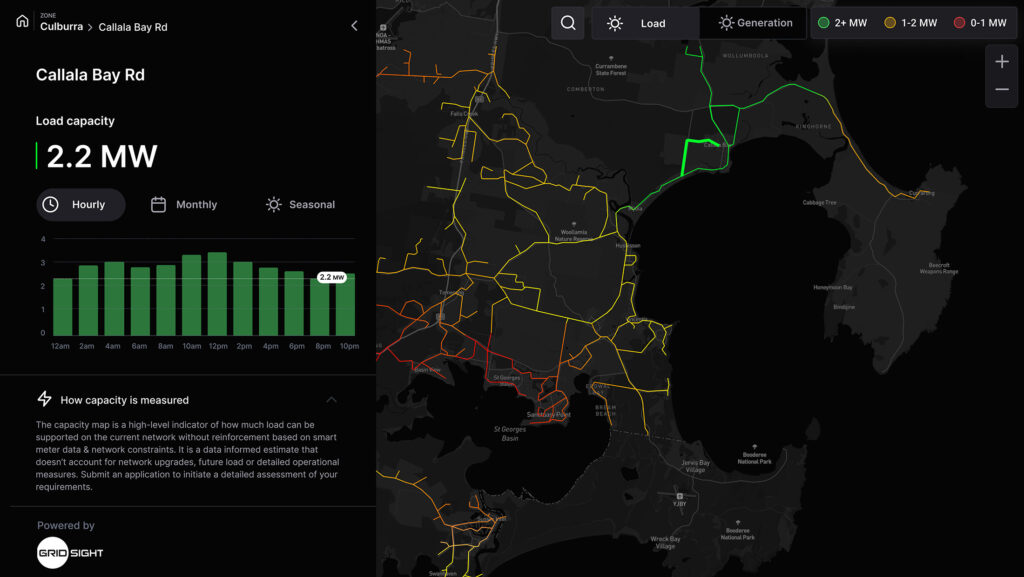
This follows the broader move from static representations toward living digital twins, where operational value depends on keeping topology, measurements and real-world conditions aligned. The International Energy Agency similarly argues that AI can improve grid forecasting, situational awareness and optimisation, but only when utilities turn meter and sensor data into operational decisions rather than simply collecting more information.
The Australian deployment provides the strongest evidence
The clearest public case comes from Endeavour Energy, which operates an electricity-distribution network in New South Wales.
Its Flexible Exports service replaces a fixed rooftop-solar export ceiling with a limit that can change according to local network conditions. Eligible single-phase customers can export as much as 10 kW when capacity is available, compared with the previous fixed 5 kW limit. The utility can reduce exports when required to protect reliability.
This is not merely a vendor presentation. An Endeavour Energy report filed with the Australian Energy Regulator says the Gridsight platform had moved into business-as-usual use, with tools for load estimation, photovoltaic-system detection, hosting capacity, power-quality monitoring and dynamic operating envelopes fully operational. At the time covered by the report, the flexible-exports trial involved more than 200 customers.
Gridsight subsequently reported that a measured cohort of 359 customers exported 171 MWh over 12 months that would otherwise have been curtailed. Endeavour projects that scaling the programme could unlock approximately 600 MW of additional rooftop-solar capacity and return more than $100 million to customers by 2035.
Those larger figures are forecasts, not independently measured outcomes. The distinction is important. The operational evidence shows that dynamic limits can release additional solar exports. It does not yet prove that the full 600 MW and $100 million will be realised.
Australia’s regulator also treats flexible export limits as one tool among several for managing hosting capacity. Its guidance stresses governance, transparency and consumer protections, including a meaningful fixed-limit alternative. From November 2026, Endeavour plans to make flexible exports the default for eligible new and upgraded solar systems, while allowing customers to opt for a lower fixed limit.
The US expansion is promising but earlier-stage
Gridsight names Xcel Energy and United Illuminating, an Avangrid subsidiary, as US customers. Public evidence is more detailed for United Illuminating.
Connecticut’s Innovative Energy Solutions programme lists a $1.1368 million project that will apply Gridsight’s platform to United Illuminating’s existing smart-meter and GIS data. The goal is to identify non-wires alternatives to conventional capital upgrades and improve hosting-capacity analysis across the utility’s service territory.
That is meaningful validation of the problem and the procurement route, but it remains a demonstration. Gridsight has not published measured US results showing shorter connection queues, avoided capital expenditure or additional capacity released. Its claims that some analyses can run 10,000 times faster and unlock 21% more capacity than assumption-based studies also lack a public independent benchmark.
Competition will be substantial. Established utility-software groups such as Siemens, GE Vernova and Schneider Electric are extending their platforms, while specialists including Camus Energy, Utilidata and Neara address overlapping parts of grid modelling, flexibility and asset intelligence. Gridsight’s advantage will depend less on the phrase “AI-powered” than on model accuracy, integration with legacy utility systems and whether regulators trust its outputs.
Software can reveal capacity, not manufacture it
The Series B arrives as data centres, electric vehicles and distributed generation compete for grid access. That creates a compelling market for software that can turn fragmented operational and geospatial data into faster decisions.
But the strongest editorial lesson is also the limitation. A digital twin can locate capacity hidden by conservative assumptions. It cannot fix an overloaded transformer, build a missing transmission line or eliminate the need for engineering review. Faster analysis may also expose institutional bottlenecks elsewhere in the connection process.
Gridsight now has funding, an operational Australian reference and initial US utility projects. The next proof point is whether it can reproduce the Australian outcome across different network models, regulations and data quality conditions. If it can, utility GIS may evolve from a record of where infrastructure is located into a continuously updated decision layer for where electrification can happen next.


#Business
Next article

Financial Information Technologies is acquiring Ground Signal, bringing consumer, menu, sales and location data into a platform already connected to 320,000 businesses. The deal shows how sector-specific location intelligence is moving closer to operational and transaction systems.
Financial Information Technologies, the Tampa-based company known as Fintech, has acquired Ground Signal, a provider of AI-powered market intelligence for the beverage alcohol industry. Financial terms were not disclosed.
At first glance, the transaction looks like a specialized analytics deal. Its geospatial significance is broader. Ground Signal has spent more than a decade organizing consumer behavior, restaurant menus, sales information and venue locations. Fintech operates a large network that processes the business relationships, invoices and product information connecting suppliers, distributors, retailers and hospitality operators.
Bringing those assets together could link a question about where demand is emerging to evidence about what products are actually moving through the market.
From a location on a map to a commercial account
Location intelligence in retail and hospitality often begins with points of interest. A database can identify that a venue exists, place it in a category and associate it with a neighborhood or trade area. The harder task is understanding what happens inside that venue and how it connects to a supply network.
Ground Signal focuses on the on-premise market, meaning bars, restaurants, hotels and other venues where drinks are consumed at the location. Its platform combines venue records with consumer signals, menu observations, supplier information and sales benchmarks. The company uses those inputs to profile accounts, identify similar venues and recommend where a brand might expand distribution or seek menu placement.
According to Ground Signal’s product documentation, its Signal.AI system can associate consumer profiles with specific on-premise locations, construct lookalike audiences and estimate the potential uplift from adding a product to a menu or back bar. The company also says users can build target-account lists from national coverage down to individual neighborhoods.
This is geographic segmentation tied to commercial action. Instead of asking only where restaurants are located, a supplier can ask which venues resemble its strongest accounts, where a cocktail category is gaining traction or which neighborhoods contain an underdeveloped distribution opportunity.
What Fintech adds
Fintech says it serves 320,000 businesses and supports more than 1.3 million business-to-business relationships across retail, hospitality and beverage alcohol. Its platform centralizes invoice and payment data, point-of-sale and delivery data, product and cost compliance, price-book management and market information.
The acquisition announcement says Fintech plans to combine that transaction and product information with Ground Signal’s consumer, menu, sales and location datasets.
The strategic logic is straightforward. Ground Signal can help identify an opportunity at a particular type of venue or in a particular market. Fintech’s network can provide additional evidence about product movement, cost, distribution and business execution. Together, those layers could allow customers to move from market observation to prioritization and measurement inside one data environment.
For example, a spirits supplier might detect growing interest in a cocktail style, identify venues whose customers and menus fit the pattern, determine whether its products already reach those accounts and measure whether a targeted program changes distribution or sales. The acquisition announcement does not confirm that this complete workflow is available today, but it explains the direction of the combined platform.
The menu is a spatial dataset
Ground Signal’s menu data illustrates both the value and the limits of this approach.
The company says it tracks brand placements across more than 150,000 US on-premise accounts. Its published documentation explains that menus are collected monthly from venue websites, assigned to account records and deduplicated when the same item appears in multiple menu sections. Natural-language processing and AI are used to classify drinks even when a familiar cocktail is listed under a custom name.
That turns an unstructured web page into attributes attached to a physical business. At scale, the resulting dataset can show how products, flavors, price tiers and cocktail styles vary between regions, venue types and neighborhoods.
The methodology also creates blind spots. A placement may be missed when a venue has no online menu, when its website record is incorrect or when a change has not yet reached the monthly collection cycle. Ground Signal says it does not accept photographs or PDFs as substitutes for its website-based process. Its documentation also notes that account records draw on Google Maps and internal venue research.
These details matter because AI recommendations inherit the coverage and freshness of the underlying location graph. A sophisticated model cannot identify an opportunity at an establishment that is missing, mismatched or represented by an outdated menu.
Why vertical location intelligence is consolidating
Generic geospatial platforms are designed to work across many industries. Vertical platforms can go deeper by defining what a location means inside one commercial system.
In beverage alcohol, a venue is not simply a point of interest. It belongs to a regulated three-tier market involving suppliers, distributors and retailers. It has menus, product placements, delivery relationships, invoices, prices and local patterns of consumption. The value of the location record increases as those attributes are connected.
This helps explain why Ground Signal may be more strategically useful inside Fintech than as a standalone analytics provider. Fintech gains a venue-intelligence and recommendation layer. Ground Signal gains access to a larger operating network and additional transaction context. Founder Melki Ko, executive Dan Adams and Ground Signal’s leadership team will join Fintech to help expand its Data & Insights offering.
The transaction also follows a wider pattern in location technology. Sector-specific datasets are increasingly being acquired by workflow, payments and operational-software providers. The buyer is not purchasing coordinates. It is purchasing a model of how activity at those coordinates relates to business outcomes.
The unanswered questions
Neither company disclosed the purchase price, integration timetable or future product structure. It is not yet clear whether Ground Signal will remain a distinct product, how quickly customers will gain access to combined datasets or whether existing contracts and interfaces will change.
Data governance deserves equal attention. Combining consumer, venue, menu, sales, delivery and transaction information can produce stronger analysis, but it also raises questions about permissions, competitive sensitivity, aggregation and who can see intelligence derived across the three-tier system. The announcement provides no detailed governance framework.
The central test will be whether Fintech can turn its larger data footprint into recommendations that are demonstrably more accurate and useful. Customers should look for evidence such as improved venue matching, measurable distribution gains, reliable uplift estimates and transparent explanations of how recommendations are produced.
If that evidence emerges, this acquisition will be a useful case study in the next stage of commercial location intelligence: not a map layered onto a business application, but geographic context embedded directly in how an industry buys, sells and decides.


