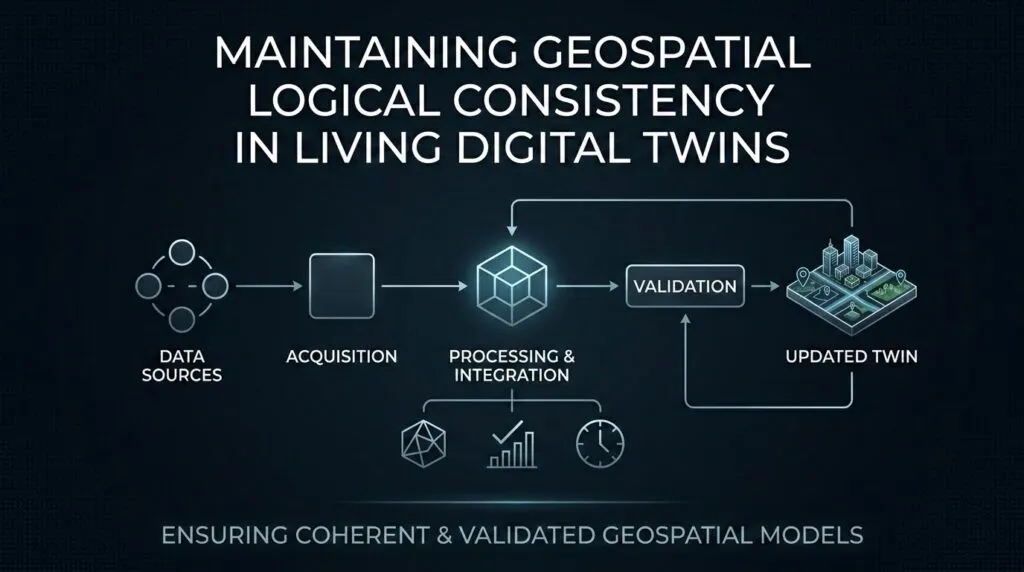
Maintaining Geospatial Logical Consistency in Living Digital Twins

Most digital twins start out being accurate, but they begin aging the moment the physical world changes.
A bridge is repaired. A road is closed. A utility line is moved. A new building appears in a satellite image. If the digital twin does not absorb these changes, it slowly becomes a reliable-looking record of the past. This is the problem with many project-based twins. They are created for a specific design, construction, or planning task, then treated as finished. The 3D model may still look impressive, but the data underneath it begins to decay.
The goal now is to move from static project twins to living digital twins. Autodesk describes digital twins as dynamic models that can evolve in real time by exchanging data with their physical counterparts. In infrastructure, this transition is already visible as digital twins move from design artifacts to tools for maintenance, inspection, and predictive planning. The market is growing rapidly, with the global digital twin market projected to increase from USD 24.48 billion in 2025 to USD 259.32 billion by 2032, reflecting a compound annual growth rate (CAGR) of 40.1%. But scale alone will not solve the problem. A living twin needs more than sensors and dashboards. It needs geospatial logical consistency.
This article looks at what that means, how autonomous conflation keeps twins aligned with the real world, why GIS teams are moving toward policy-based auditing, and how evergreen urban models can support routing, disaster simulation, and predictive maintenance.
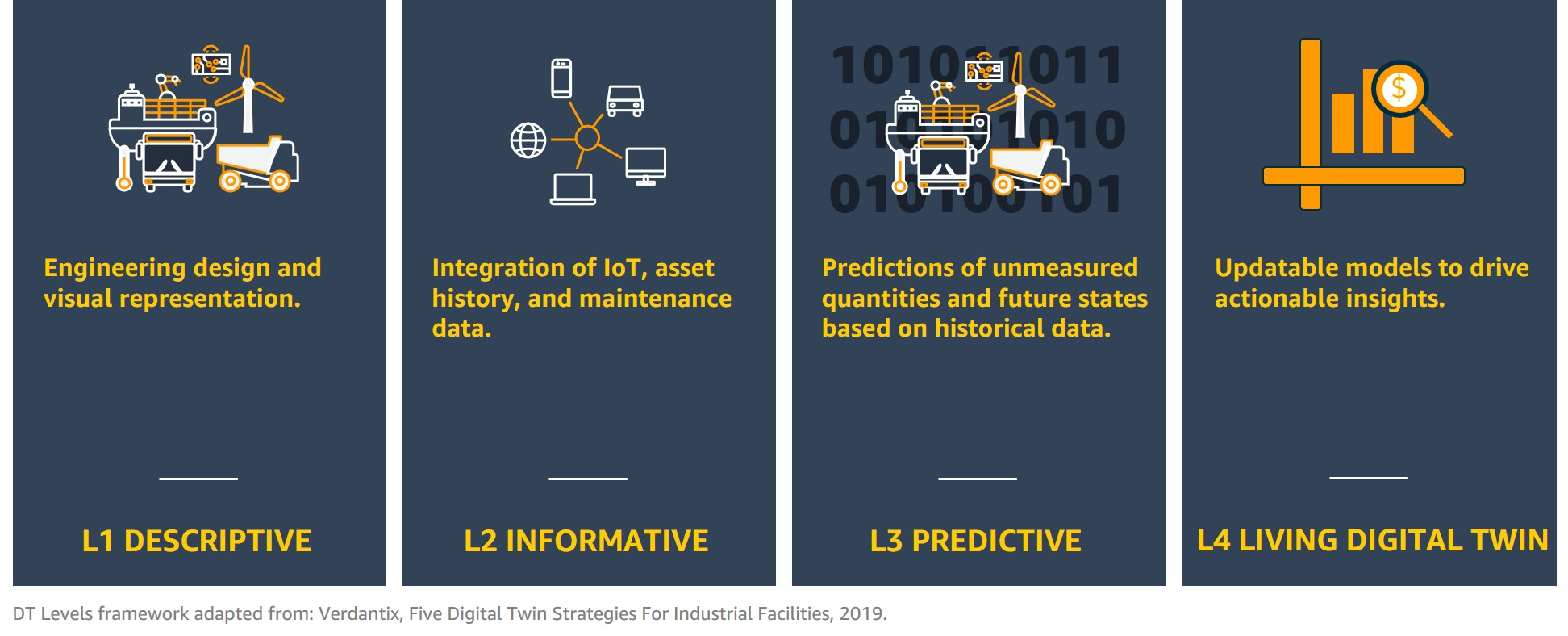 Digital Twins Levels Framework. Source: AWS
Defining Geospatial Logical Consistency
A digital twin is not useful just because it looks realistic. It also has to behave correctly.
This is where geospatial logical consistency comes in. It means the data inside the twin follows spatial rules. Roads should connect to roads. Pipes should meet at valid junctions. Buildings should not float across parcel boundaries. A bridge should cross a river, not sit beside it with no connection. In GIS, many of these rules are handled through topology. Topology defines how points, lines, and polygons share geometry, connect to each other, and maintain valid relationships. Without it, a digital twin becomes a hollow shell. It may look correct on screen, but it cannot support routing, simulation, or reliable analysis. This matters even more when updates become automated. A living twin may receive new data from drones, IoT sensors, mobile mapping systems, and satellite imagery. Each source may be useful, but each can also introduce errors.
That is why a living twin needs spatial rules as guardrails. A road cannot pass through a building without explanation. A water pipe cannot connect to an electrical cable. A new building footprint should not erase a legal boundary unless there is trusted evidence.
This connects to the wider idea of geospatial reasoning. The twin must understand relationships, not just recognize objects. Some industry discussions call this the rise of self-healing digital twins. The idea is that the system can detect inconsistent data, flag the problem, and sometimes suggest a correction.
Autonomous Spatiotemporal Conflation
A living digital twin cannot depend on one perfect dataset. It has to merge many imperfect ones.
That process is called conflation. In GIS, conflation aligns features from different geographic layers and transfers useful attributes from one layer to another. In a living twin, this becomes spatiotemporal. The system is not only asking, “Where is this feature?” It is also asking, “When was this version true?” 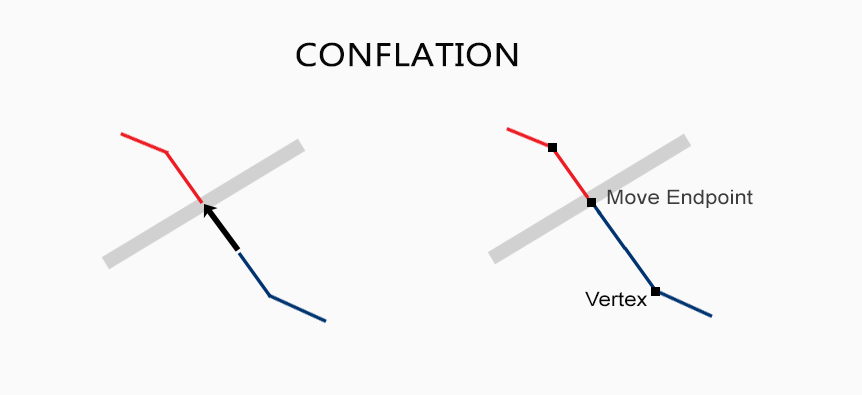
Source: GIS Geography
This matters because a city twin may contain several versions of reality at once. A legacy utility map may show where a pipe was installed years ago. A drone scan may show that the road above it has changed. An IoT sensor may show that water pressure is dropping right now. The twin has to combine these signals without creating contradictions.
This is where source authority becomes important. Not every dataset should have the same weight. A live utility sensor may be more trusted for a current outage. A cadastral layer may be more trusted for a legal boundary. A drone scan may be more trusted for recent surface damage.
The same logic appears in wider digital twin architecture. Recent discussions around federated digital twins point to shared semantics, open standards, and governance as key requirements for connecting many systems.
The Transition: From Manual Editing to Policy-Based Auditing
In a living digital twin, GIS teams cannot update every feature by hand.
The work moves from drawing data to governing data. Instead of manually digitizing every new curb, pipe, road closure, or asset change, teams define spatial policies. These policies decide what counts as a valid update, which source has priority, how topology should be preserved, and when a change needs review.
This is already part of strong GIS data management. Good spatial systems need standards, schemas, ownership, and automated quality checks so the data remains current and trustworthy.
The same idea becomes more important in living digital twins. A city twin may receive updates from road sensors, drone surveys, utility systems, and public agencies. Without clear rules, automation can create confusion instead of clarity.
This is also why sovereign data spaces matter for smart cities. They allow different agencies to share data through trusted frameworks without losing control of their own information.
As twins become more automated, the human role changes. GIS professionals become auditors. They do not check every routine update. They focus on edge cases where the system finds a conflict, uncertainty, or rule violation.
This connects to the rise of Agentic GeoAI, where systems can monitor data, run spatial operations, and suggest actions. But autonomy does not remove human judgment. It makes human judgment more targeted.
Some digital twin discussions describe this next stage as cognitive twins, where systems understand context, not just data patterns.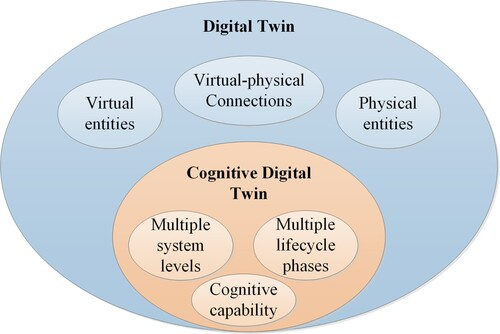
Relation between digital twin and cognitive digital twin. Source: Zheng et al.,2022
Case Study: The “Evergreen” Urban Model
An evergreen urban model is a city-scale digital twin that does not wait for a yearly update. It updates through repeated healing cycles.
The cycle is simple. New data arrives from drones, sensors, permits, field teams, satellites, or connected infrastructure. The twin compares that data with its trusted base layers. If the change follows the rules, the model updates. If it creates a conflict, the system flags it for review. This is how a city twin stays alive.
Virtual Singapore is an early example of this direction. It is a detailed 3D model that supports simulations and virtual testing for urban planning. Other sources describe its use for flood analysis, solar panel opportunities, green roofs, and wind impact studies.
Helsinki shows the climate side of the same idea. Its city-scale digital twin supports sustainability and quality-of-life work, while the Energy and Climate Atlas helps model building-level energy consumption for carbon-neutral planning.
The value becomes even clearer during disasters. In Cauayan City, Philippines, a digital twin built from drone imagery has been used to assess damage to houses, crops, infrastructure, and livestock after storms.
Smart mobility is another downstream benefit. Las Vegas has explored a digital twin that collects data on mobility, traffic, air quality, noise, and emissions to test future city scenarios.
In all these cases, the twin is useful because it keeps moving with the city. The goal is not just a better 3D model. It is a trusted operational layer for routing, climate planning, disaster response, and maintenance.
Try it yourself: a simple living digital twin in Cesium
To make this idea easier to understand, you can run a small example of a city digital twin in your browser.
First, open Cesium Sandcastle at https://sandcastle.cesium.com/ and go to the code editor. Copy and paste the code below and run it.
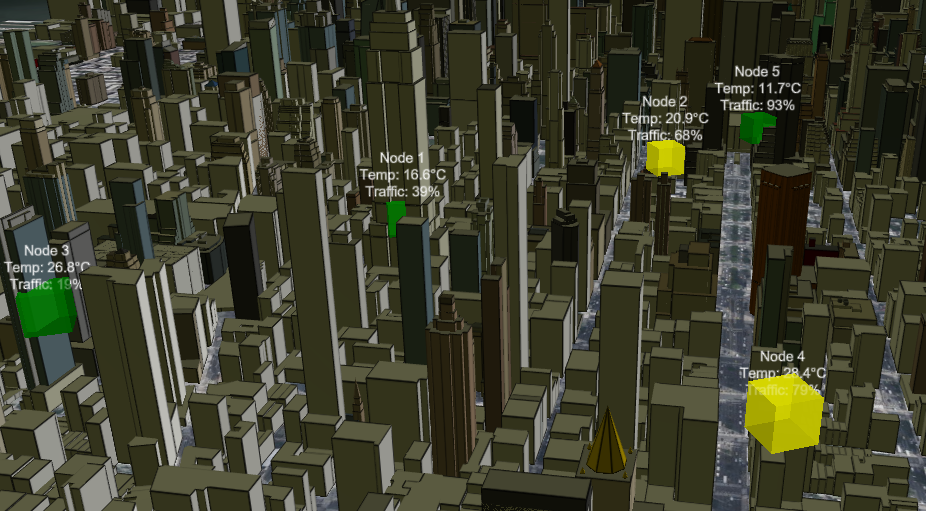
This example creates a small network of sensor nodes placed in a 3D city. Each node simulates changing local conditions such as temperature and traffic. The camera then focuses on the centre of all nodes, so you can see the whole system as one connected area.
What this shows is the basic idea behind a living digital twin: multiple spatial points updating together inside a consistent geospatial space.
import * as Cesium from "cesium";

// Viewer setup
const viewer = new Cesium.Viewer("cesiumContainer", {
  terrain: Cesium.Terrain.fromWorldTerrain(),
});

// OSM Buildings
const osmBuildingsTileset = await Cesium.createOsmBuildingsAsync();
viewer.scene.primitives.add(osmBuildingsTileset);

// Sensor positions [lon, lat]
const sensorPositions = [
  [-73.9857, 40.7484],
  [-73.9810, 40.7495],
  [-73.9900, 40.7470],
  [-73.9835, 40.7435],
  [-73.9785, 40.7505],
];

// Create sensor entities
const sensors = [];

function createSensor(lon, lat, i) {
  return viewer.entities.add({
    position: Cesium.Cartesian3.fromDegrees(lon, lat, 80),
    box: {
      dimensions: new Cesium.Cartesian3(40, 40, 40),
      material: Cesium.Color.CYAN.withAlpha(0.9),
    },
    label: {
      text: `Node ${i + 1}`,
      font: "14px sans-serif",
      fillColor: Cesium.Color.WHITE,
      pixelOffset: new Cesium.Cartesian2(0, -40),
    },
  });
}

sensorPositions.forEach((p, i) => {
  sensors.push(createSensor(p[0], p[1], i));
});

// Compute centroid in world space
const cartesianPoints = sensorPositions.map(p =>
  Cesium.Cartesian3.fromDegrees(p[0], p[1])
);

let centroid = cartesianPoints.reduce(
  (acc, p) => Cesium.Cartesian3.add(acc, p, new Cesium.Cartesian3()),
  new Cesium.Cartesian3()
);

centroid = Cesium.Cartesian3.multiplyByScalar(
  centroid,
  1 / cartesianPoints.length,
  new Cesium.Cartesian3()
);

// Camera focus on centroid
viewer.scene.camera.lookAt(
  centroid,
  new Cesium.Cartesian3(0.0, 0.0, 1500)
);

// Simulation loop — updates every 1.2 s
setInterval(() => {
  sensors.forEach((sensor, i) => {
    const temp      = 10 + Math.random() * 25;
    const traffic   = Math.random() * 100;
    const intensity = temp + traffic / 6;

    sensor.box.material =
      intensity < 30 ? Cesium.Color.GREEN.withAlpha(0.9)
    : intensity < 45 ? Cesium.Color.YELLOW.withAlpha(0.9)
    :               Cesium.Color.RED.withAlpha(0.9);

    sensor.label.text =
      `Node ${i + 1}\nTemp: ${temp.toFixed(1)}°C\nTraffic: ${traffic.toFixed(0)}%`;
  });
}, 1200);
The visualisation will look like this:
A living digital twin is not defined by how detailed it looks. It is defined by how much it can be trusted.
That trust depends on consistency. Roads must connect, assets must update, and conflicts must be traceable. When the world changes, the twin must know what changed, which source to trust, and when a human should step in.
This is why geospatial logical consistency is becoming central to the future of digital twins. It turns the twin from a static model into a reliable operational layer.
Did you like this article? Read more and subscribe to our monthly newsletter!


#Contributing Writers

Next article

EUSPA launches new EU Space Market Report
The new edition of the EU Space Market Report was published today. For the first time it brings Global Navigation Satellite Systems (GNSS), Earth observation (EO), Secure Satellite Communications, and Space Situational Awareness (SSA) into a single publication, with 16 market segments analysed across the downstream sector.
Bringing together GNSS, Earth Observation, Secure SATCOM, and Space Situational Awareness within a single publication reflects the growing synergies between these domains and their strategic importance for Europe’s economy, resilience, and autonomy.
— Rodrigo da Costa, EUSPA Executive Director
GNSS and EO: a decade of sustained growth
Both markets show sustained growth across all 16 analysed segments. GNSS revenues are forecast to climb from over €300 billion in 2024 to more than €580 billion by 2034, while EO rises from €3.5 billion to €7.9 billion over the same period. Notably, GNSS service revenues are outpacing device revenues — by 2034, enabled services are expected to account for almost 80% of total GNSS revenue.
Annual GNSS device shipments are projected to grow from 1.75 billion units in 2024 to roughly 2.4 billion by 2034, with Consumer Solutions and Road and Automotive together accounting for the majority. Asia-Pacific is now the largest regional GNSS market by revenue.
Where EO revenues come from
Agriculture is the single largest EO segment, accounting for around 21% of revenues in 2024 and forecast to remain among the fastest-growing through 2034. The European supply side leads globally with a 42% share of EO revenues, while the US and Europe combined hold more than 83%.
Secure SATCOM: demand shifting toward security and crisis response
The Secure SATCOM market is structured around three pillars — surveillance, key infrastructure, and crisis management — covering 12 use cases. Data service revenues from EU users are forecast to climb from just over €200 million in 2025 to nearly €1.2 billion by 2040. Maritime surveillance drives demand today; by 2040 the market is expected to be led by law enforcement, civil protection, and force deployment.
Why a single report now
The report examines how climate change, geopolitical instability, and rapid urbanisation are reshaping space markets and pushing EO, GNSS, and Secure SATCOM closer together. Modern downstream products increasingly combine all three — and depend on SSA to keep the underlying space assets safe — which is the case EUSPA is making for treating them as one ecosystem rather than four standalone markets.
Did you like this post? Read more and subscribe to our monthly newsletter!