GeoAI in Earth Observation: What’s Real, What’s Hype, and What’s Next

There’s never been more excitement around AI in Earth observation — and never more confusion about what’s actually working versus what’s still a compelling slide deck. Foundation models, autonomous satellite agents, hyperspectral “x-ray vision,” real-time onboard AI — the promises are extraordinary. But which of these technologies are delivering real value today, and which ones are still five to ten years away from maturity?
To answer that, Geoawesome and UP42 partnered on a new report: “AI in Earth Observation: What’s Real and What’s Next” — a grounded, strategic look at the GeoAI landscape using the Gartner Hype Cycle as a compass.
The Hype Cycle as a Reality Check
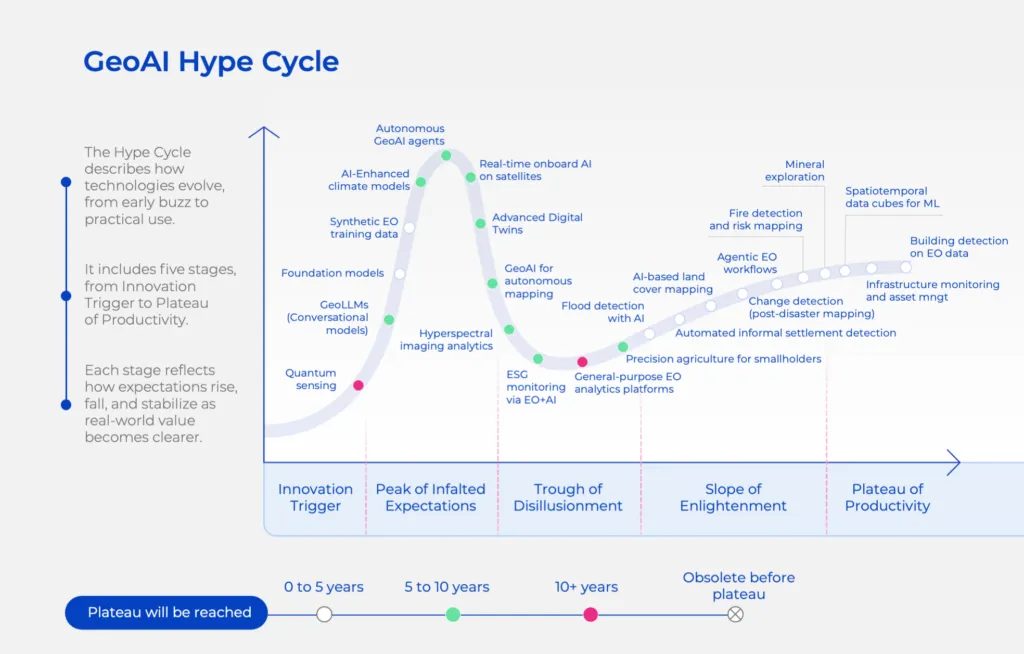
The report maps 25+ GeoAI use cases across all five stages of the Hype Cycle, from the Innovation Trigger through to the Plateau of Productivity. The result is a field that is simultaneously more mature than many realise, and more hyped than it should be in certain corners.
What’s already on the Plateau of Productivity?
What’s climbing the Slope of Enlightenment?
What’s in the Trough of Disillusionment?
What’s still at Peak Hype?
The GeoAI Building Blocks Framework
Beyond the Hype Cycle, the report introduces the GeoAI Building Blocks Framework — a structured way to think about what it actually takes to build operational GeoAI systems. Think of it as a house: the Use Case is the bedrock (the “job to be done” that justifies every investment), five Pillars support the structure (Data, Infrastructure, Models, Engineering, and Governance), and the Roof is the Business Outcome — the ROI, risk mitigation, or cost-savings that the end user actually sees.
Too many EO projects fail because they’re “roof-heavy” — focused on outcomes without building the data foundations beneath them. Or “pillar-less” — with good data and models but no engineering to connect them into something autonomous and scalable. The framework is a blueprint for avoiding both failure modes.
The Data Pillar in 2026 is less about “data collection” and more about “insight orchestration.” Platforms like UP42 aggregate multi-constellation EO data through a single API, dramatically reducing time-to-market. The Infrastructure Pillar has shifted from local servers to cloud-native geospatial platforms with GPU clusters for training and edge-computing for real-time inference. The Governance Pillar — transparency, bias mitigation, regulatory compliance with standards like the EU AI Act — has gone from afterthought to load-bearing wall.
From Pixels to Answers
The most important shift described in the report is not technical — it’s commercial. The next frontier for Earth observation is a move from selling pixels to selling answers. Flood alerts in real time. Asset-level carbon monitoring for ESG compliance. Vegetation insights that prevent wildfire outbreaks. That’s what industries will pay for, not raw imagery or demo dashboards.
The winners over the next five years won’t be the companies that collect the most imagery. They’ll be the ones that turn planetary data into reliable, decision-grade intelligence — embedded directly into the workflows of agriculture companies, insurers, infrastructure operators, and public agencies.
Watch the Panel Discussion
To go deeper on these themes, we also hosted a live discussion exploring how AI is transforming Earth observation — separating the operational reality from the next frontiers. You can watch the full panel here: AI in EO: What’s Real and What’s Next — Panel Discussion
Get the Full Report
The full report covers all 25+ GeoAI use cases mapped to the Hype Cycle, deep dives into each building block of the GeoAI Framework, and strategic guidance for innovation leads, product managers, and data leaders on where to invest now and what to pilot next.
Download the full report here →
This report was developed in collaboration between Geoawesome and UP42.


#Deep Tech



Next article
A popular desktop application bows out after two decades, satellites count the world’s cultural treasures, and the maps in our pockets start talking back. March 2026 was a quieter month on the surface; but beneath it, the infrastructure of how we read and understand our planet keeps getting rebuilt.
The Whole Earth in a Single Frame
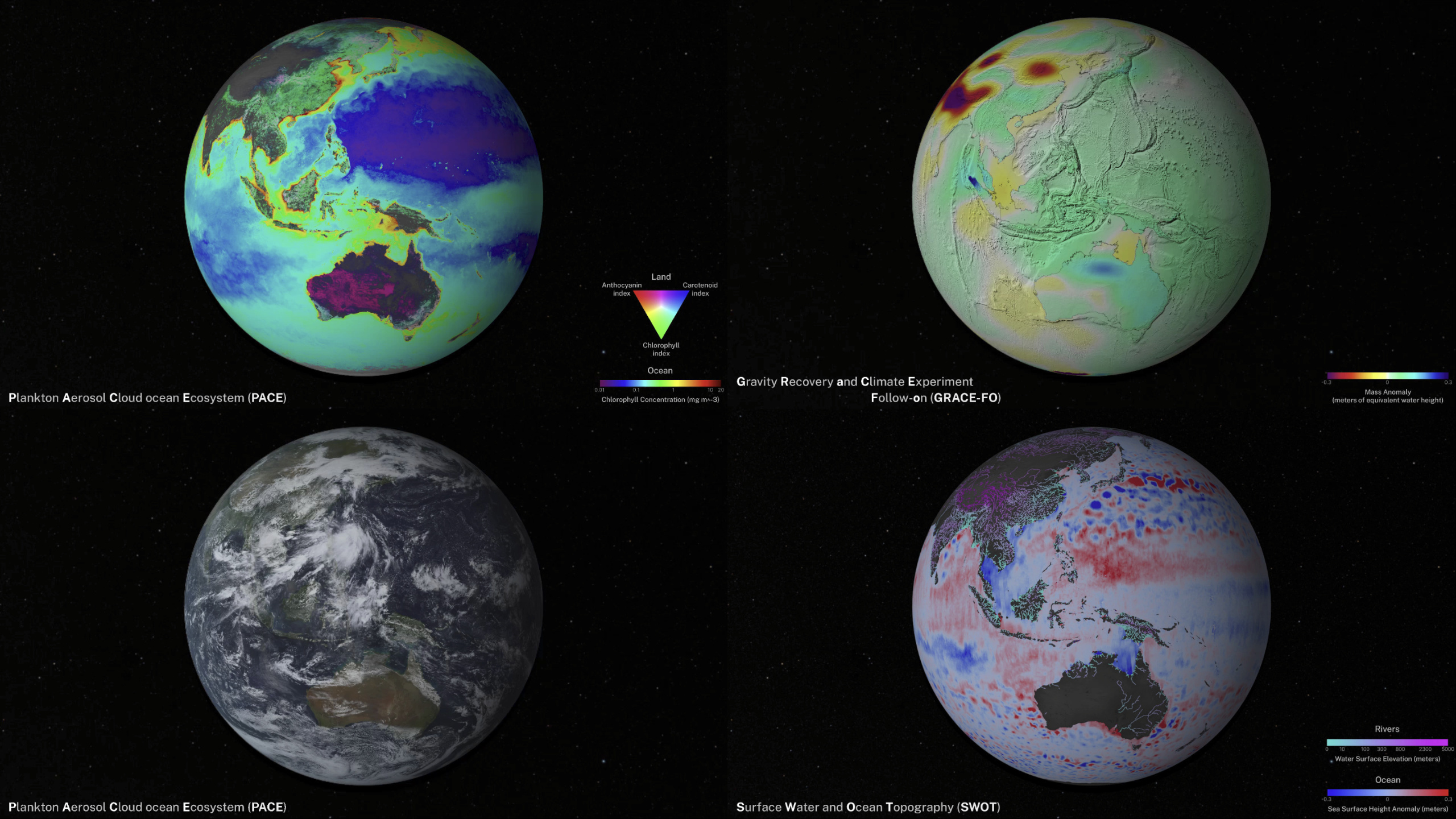
NASA’s Scientific Visualization Studio has released two compelling pieces of content that remind us just how extraordinary our planetary monitoring capabilities have become. The first is a stunning rotating globe animation, The Earth System Science Spheres, which cycles through datasets from four of Earth’s five major spheres: PACE true-colour for the atmosphere, PACE ocean colour and land vegetation pigment for the biosphere, SWOT river water height and sea surface height anomaly for the hydrosphere, and GRACE-FO mass anomaly for the geosphere. It is the kind of visualization that puts the entire integrated Earth system into a single, beautiful sequence, a reminder of how much data humanity now collects about its own planet.
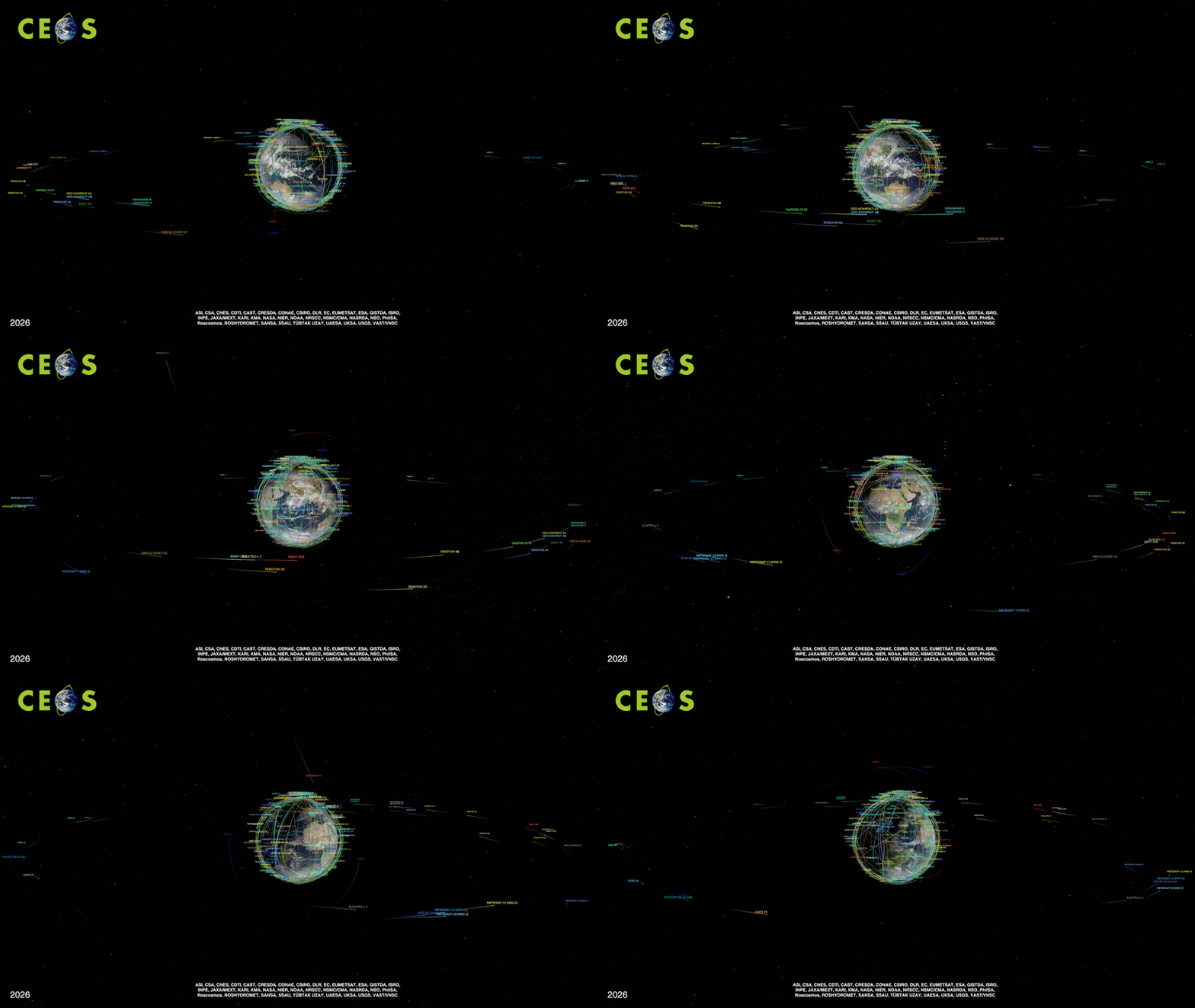
The second release, the 2026 CEOS Fleet visualization, offers a complementary view from the outside looking in: a global map of every Earth Observation satellite now circling the planet, produced by the Committee on Earth Observation Satellites (CEOS). Seeing hundreds of individual orbital paths laid out together is genuinely striking. The coordinated fleet that now watches our planet continuously, through cloud, night, and season, is one of the great engineering achievements of our era, and most people have never heard of CEOS.
Related reading: Earth observation satellites, Meteosat weather satellites
Landsat at 50-Plus: Still Delivering Science, Not Just Scenery
Landsat 9 continues to demonstrate that Earth observation satellites are scientific instruments first and image factories second. NASA’s in-depth feature on Landsat 9 highlights how the mission’s two instruments, the Operational Land Imager 2 (OLI-2) and the Thermal Infrared Sensor 2 (TIRS-2), contribute calibrated, multi-decade data for tracking glacial retreat, forest cover change, agricultural water use, and urban heat islands. It is a good read for anyone who still thinks of Landsat primarily as a source of pretty pictures: the programme’s scientific legacy and long-term data continuity are what make it irreplaceable.
Further reading: How glaciers flow with the seasons
Copernicus Climate Bulletin: February Was Warm and Wet
The Copernicus Climate Change Service reported that February 2026 was the fifth warmest February on record globally, while western Europe experienced exceptionally wet conditions. The bulletin continues a now-familiar pattern of monthly records that keep nudging the baseline upward. For the geospatial community, reports like this are not just climate news, they are the operational context that makes real-time Earth observation infrastructure relevant and urgent.
Related: Temperature contrasts in the Northern Hemisphere, AI and weather tech reshaping climate risk
Google Maps Goes Conversational
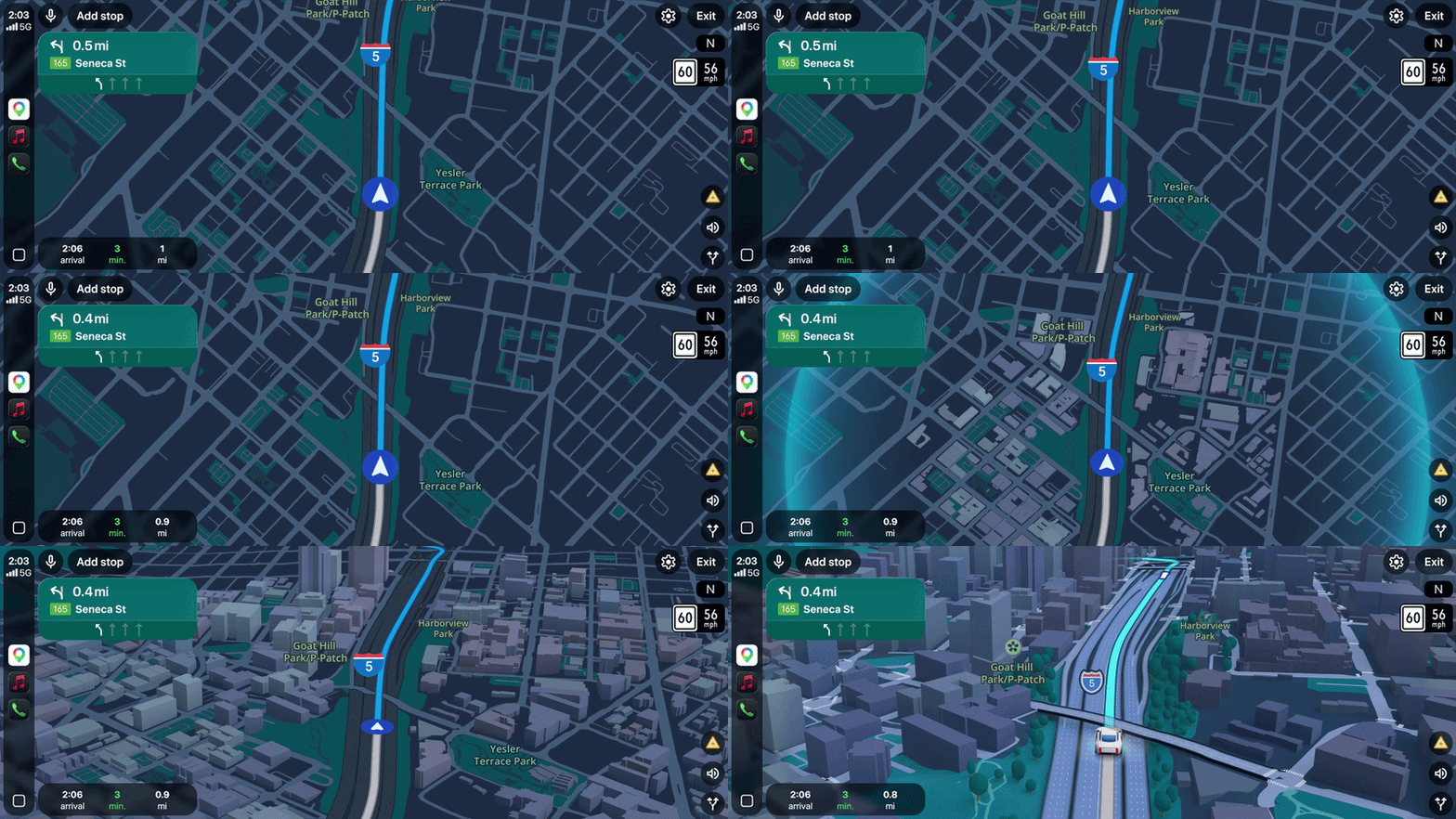
One of the highest-profile geospatial product announcements of the month came from Google. Ask Maps, powered by Gemini, allows users to ask natural language questions, “find a quiet coffee shop near the park where I can bring my dog”, and receive contextually aware responses that draw on the rich local data layer Google has built over two decades. Paired with an upgraded Immersive Navigation mode that renders realistic 3D environments during turn-by-turn guidance, these updates signal a meaningful shift in how mass-market mapping interfaces work. The integration of conversational AI into navigation is not a gimmick; it is a direct consequence of the explosion in structured geospatial data and the maturation of large language models capable of reasoning over it. TechCrunch covered the announcement in detail.
Comparison reading: Google Maps vs. Waze, Maps alternatives review
IBM Releases TerraStackAI for Earth and Space Geospatial Workflows
IBM Research published a major open-source release: TerraStackAI, an integrated technology stack designed to cover the full geospatial AI workflow from data preparation to production deployment. The ecosystem builds on IBM-NASA’s Prithvi-EO and IBM-ESA’s TerraMind foundation models, and packages them into four interoperable components: TerraKit for AI-ready data preparation (query, align, label); TerraTorch for fine-tuning and evaluating foundation models; Iterate for Bayesian hyperparameter optimisation; and a new Geospatial Studio for operationalising production services. A companion release on Red Hat OpenShift AI means enterprise teams can now deploy Earth and space AI models at scale in their existing infrastructure. For practitioners who have found working with geospatial foundation models fragmented and inaccessible, TerraStackAI addresses exactly that gap. This is open-source tooling that deserves wide attention from the EO and GeoAI communities.
Background: NVIDIA Earth 2 open models
GeoAI Enters the Hydrographic Office
Hydrographic offices and maritime authorities are not typically the first adopters of new technology, but a detailed case study from Hydro International documents how geospatial AI is beginning to reshape hydrospatial workflows. From AI-assisted quality control and automated chart updating to natural-language-interface help systems, the article describes a sector beginning to move from labour-intensive manual processes towards smart, AI-augmented pipelines. The underlying logic, that maritime navigation, port management, and the blue economy broadly depend on accurate, up-to-date spatial data, means this transformation is genuinely consequential.
Rubin Observatory: A New Kind of Sky Survey
Geospatial data does not have to be terrestrial, and the Vera C. Rubin Observatory’s first real-time sky alerts are a reminder of that. On 24 February, the observatory’s Legacy Survey of Space and Time (LSST) system successfully generated 800,000 public alerts of changes in the night sky in a single night, every one of them flagging a transient event like a moving asteroid, a variable star, or a possible supernova. The alerting system is ultimately expected to generate up to seven million alerts per night. For the GIS community, this is a fascinating parallel: the same challenges of real-time change detection, spatial querying at scale, and alert-driven workflows that Earth observation teams grapple with are now playing out across the entire Southern Hemisphere sky. Stellar cartography has become, functionally, a geospatial discipline.
Explore: Astrocartography travel trend
ArcMap Retires: A Milestone for the GIS World
On 1 March 2026, Esri officially retired ArcGIS Desktop, including ArcMap, ending support for software that helped define what GIS meant for an entire generation of practitioners. For many professionals, ArcMap was not just a tool but the environment in which they first understood spatial thinking, built their first maps, and developed the workflows that shaped their careers. The retirement is not an ending but a marker of how far the platform has evolved: from single-desktop application to a modern, web-first, mobile-inclusive ecosystem. ArcGIS Pro, ArcGIS Online, and Field Maps are the successors, and Esri has published migration guides for teams still transitioning. For those who want alternatives, a roundup of ArcGIS alternatives also circulated this month, covering QGIS, Mapbox, and other open and commercial options.
Professional development: Ultimate GIS guide for mining professionals
ArcGIS Platform Updates: SDK 5.0, Imagery Enhancements, and Cartographic Play
Several platform-level updates from Esri are worth noting for developers and analysts:
The ArcGIS Maps SDK for JavaScript version 5.0 introduces a genuinely significant addition: an AI assistant component (beta) for agentic web mapping applications. Developers can now embed a conversational interface, with navigation, data exploration, and help agents, directly into map applications using a small amount of markup. The SDK also adopts semantic versioning for the first time, making upgrade planning much more predictable.
The February 2026 imagery update for ArcGIS Online brings enhanced hyperspectral support (new AVIRIS and EMIT raster types), two new raster analysis tools (Geomorphon Landforms and Summarize Categorical Raster), and a new Accelerated Analysis beta that speeds up deep learning workflows at no additional cost.
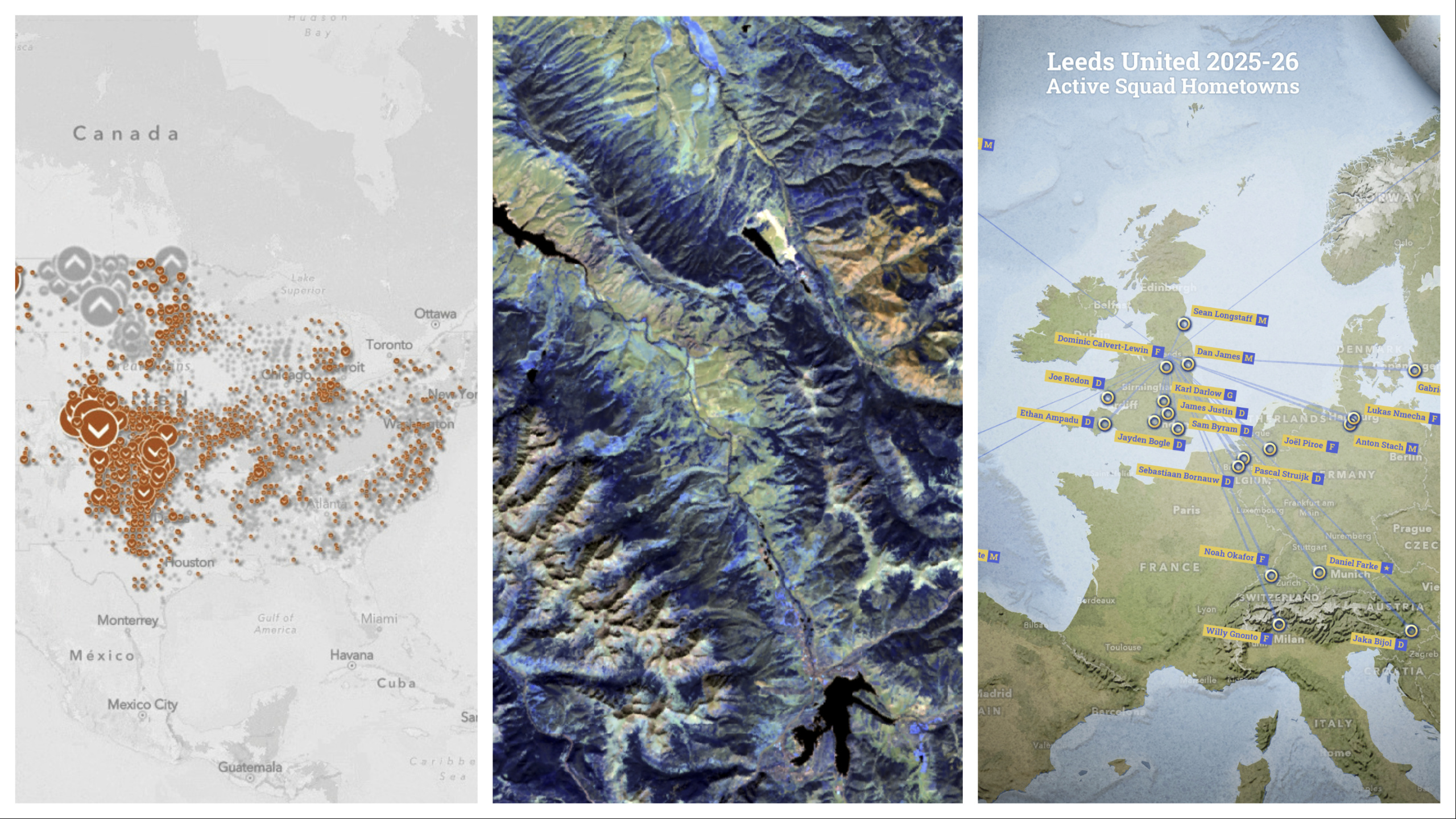
And for those who care about the craft side of cartography, John Nelson’s blog post on how to “enthingify” maps with cartoon imagery and chunky overview globes, his word, and a good one, is pure map-making joy. The technique involves applying raster functions to produce illustration-style imagery, blending terrain layers, and adding cast-shadow overview globes that give a map physical weight and presence. Maps that feel touchable, Nelson argues, are maps that communicate. This kind of craft thinking belongs in the professional GIS conversation.
For cartographic craft, explore: Cartoon imagery and chunky overview globes, 3D printable STL creation
ESA’s Celeste and the Future of LEO-Based Navigation
ESA launched Celeste, its LEO-PNT experimental satellite, on 24 March, a demonstration mission exploring Low Earth Orbit positioning, navigation, and timing as a complement or backup to traditional GNSS constellations. LEO-PNT is one of the more important concepts in navigation right now: signals from low-orbit satellites are significantly stronger and faster than those from medium-orbit GNSS, with potential to improve indoor positioning, provide resilience against jamming and spoofing, and open up use cases that GPS alone cannot reliably support. Celeste is an early but meaningful step.
On the commercial side, Digital Mapping Group released FastXY, a high-precision GNSS mapping app aimed at survey and field mapping professionals who need centimetre-level accuracy on mobile devices.
Space infrastructure: Arctic weather satellite paves constellation
Copernicus and Cultural Heritage: Satellites as Guardians of the Past
One of the meaningful threads in this month’s news is the growing role of Copernicus data in cultural heritage monitoring. The Copernicus World Heritage Hub aggregates Copernicus products for monitoring and managing UNESCO World Heritage Sites. The use cases are concrete: detecting ground subsidence threatening ancient monuments, tracking coastal erosion around historic settlements, mapping urban expansion into heritage buffer zones, and assessing conflict damage to archaeological sites. For anyone interested in this intersection, Copernicus supporting disaster resilience in Europe offers complementary perspective.
Learn more: Satellite imagery and AI reveal hidden development needs, Mapping cemeteries with drones and phones
StoryMaps: Geospatial Storytelling in Practice
Several notable ArcGIS StoryMaps collections were shared this March. They represent the continuing maturation of StoryMaps as a medium for communicating spatial insight to non-specialist audiences. Explore these examples: StoryMap Example 1, StoryMap Example 2
For anyone building a public-facing geospatial product or report, the current generation of StoryMaps templates offers a high baseline for quality.
Compiled by the Geoawesome team. Got something we missed? Reach out, we read everything.
Did you like this post? Read more and subscribe to our monthly newsletter!