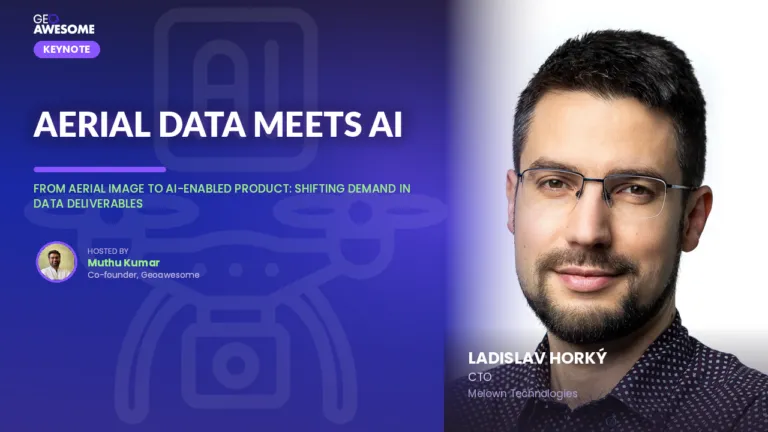
From Aerial Image to AI-Enabled Product | The Next Geo by Geoawesome
The first aerial photographs were worth their weight in gold. Since then, digital cameras, aerial LiDAR, hybrid sensors, and AI powered processing have completely changed what a data deliverable can be.
In this keynote, Ladislav Horký, CTO of Melown Technologies, looks at what's possible today given the sheer abundance of raw aerial data now available, and where the next wave of AI-enabled products is headed.
In this keynote, Ladislav Horký, CTO of Melown Technologies, looks at what's possible today given the sheer abundance of raw aerial data now available, and where the next wave of AI-enabled products is headed.
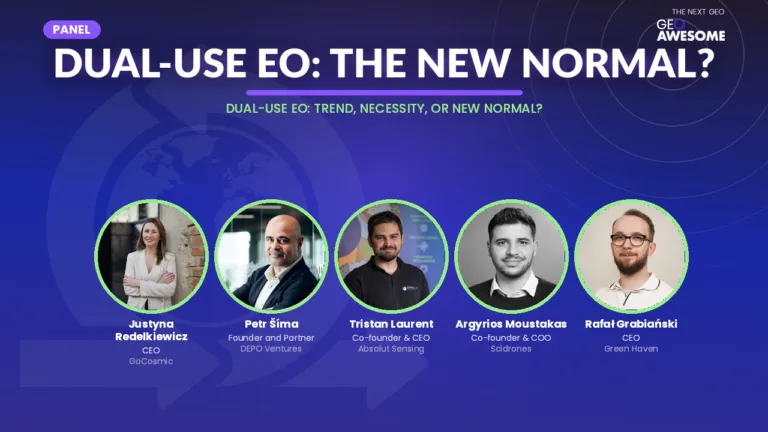
Dual use EO trend necessity or new normal | The Next Geo by Geoawesome
From climate monitoring to critical infrastructure and defense, the same Earth observation data is increasingly powering very different missions at once.
This rapid-fire panel brings together founders and leaders from EO startups building downstream solutions to unpack the biggest dual-use opportunities on the table, the hard constraints around regulation, ethics, and trust, and where they think the market is actually headed over the next two years.
This rapid-fire panel brings together founders and leaders from EO startups building downstream solutions to unpack the biggest dual-use opportunities on the table, the hard constraints around regulation, ethics, and trust, and where they think the market is actually headed over the next two years.
Geo4Good Teaching Drones in Africa | The Next Geo by Geoawesome
The African Drone and Data Academy, run by UNICEF, is training a new generation of African drone pilots and data specialists to tackle local challenges with local talent, from public health logistics to disaster mapping and agriculture.
In this Geo4Good session, Michael Scheibenreif and Keren Asaba from ADDA talk about how the academy builds hands-on drone and data skills across the continent, the real-world problems its graduates are already solving, and what it takes to scale drone education sustainably in the region.
In this Geo4Good session, Michael Scheibenreif and Keren Asaba from ADDA talk about how the academy builds hands-on drone and data skills across the continent, the real-world problems its graduates are already solving, and what it takes to scale drone education sustainably in the region.
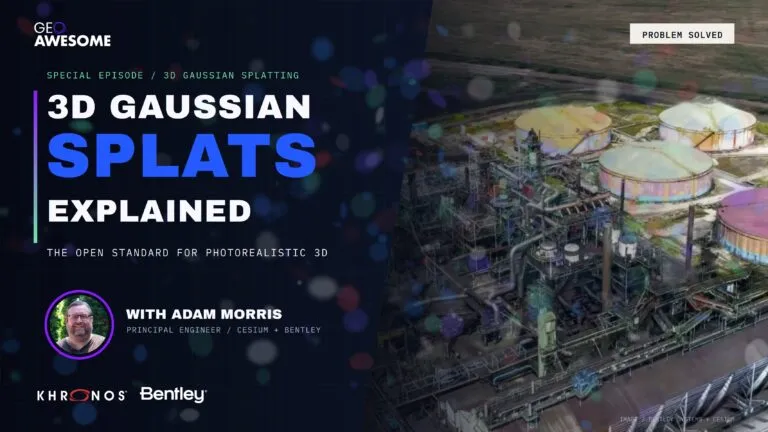
The End of Blurry Point Clouds: 3D Gaussian Splatting Explained
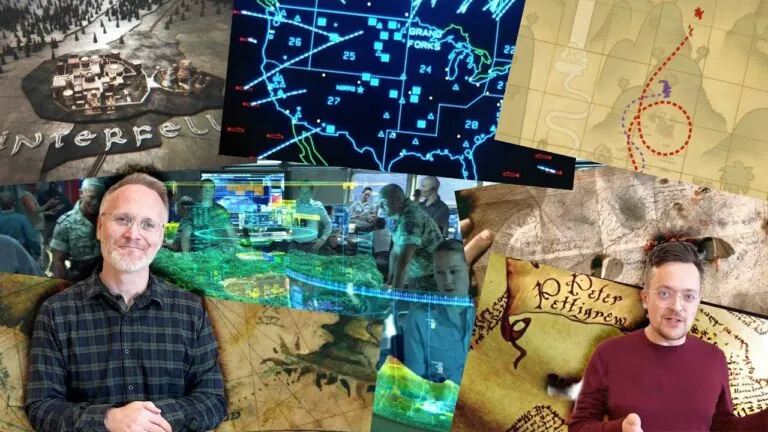
Expert Reviews MOVIE MAPS
John Nelson and Peter Attwood review maps in films. What they get right, what they might get wrong, and what we think of them as cartography nerds.
Scaling Change Detection: Why tasking is a thing of the past | Problem Solved | Geoawesome Podcast
In this episode of Problem Solved — the Geoawesome podcast — host Muthu sits down with Don Osborne, CEO of Earth Daily Analytics, to explore why reliable, daily Earth observation has been so hard to achieve — and how Earth Daily is building the infrastructure to finally crack it.
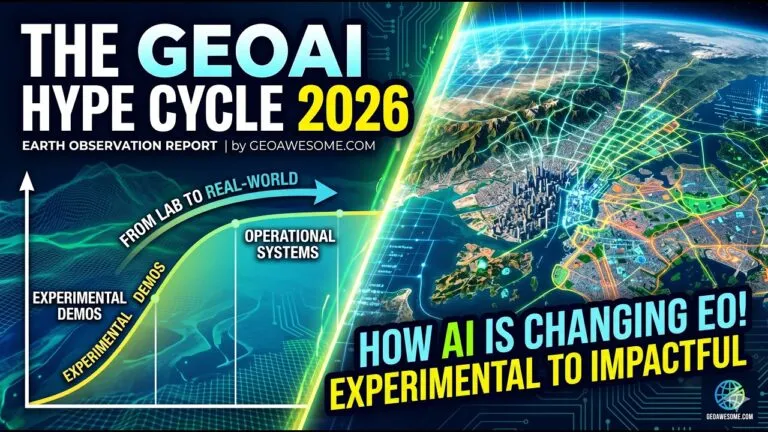
GeoAI Hype Cycle 2026 What’s Real, What’s Next in AI Powered Earth Observation
Join us for the official launch of the new GeoAI Hype Cycle 2026 report. This session will unpack the most forward-looking analysis yet of how artificial intelligence is transforming Earth Observation—from experimental lab demos to operational systems delivering real-world impact.
TW Landsat 9 – More Than Just A Picture
For over 50 years, the Landsat program has provided the longest continuous satellite record of Earth's land surface from space. Landsat 9, launched in 2021, is the latest mission in this remarkable legacy — building on decades of Earth observation with upgraded technology, including enhanced radiometric resolution, improved signal-to-noise performance, and polar night thermal imaging. Working in tandem with Landsat 8 to map the entire planet every eight days, Landsat 9's data is being fused with the European Space Agency's Sentinel-2 satellites to enable near-daily global observations, delivering sharper, more detailed observations that help scientists and communities monitor a changing planet.
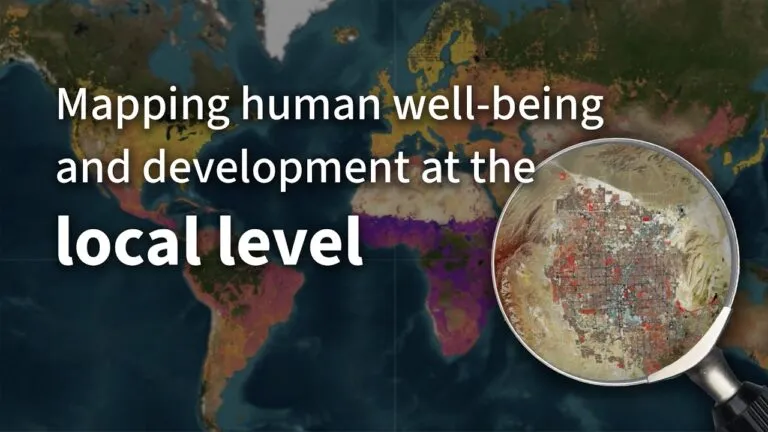
Mapping human well-being and development at the local level
Researchers have mapped relative levels of human well-being and development for thousands of municipalities around the world. The new approach could help fill gaps in census data and inform decisions about how to tailor policies and programs to local needs.

GeoAI: The new frontier of Financial intelligence | GIST Impact | AI & Geospatial Dialogue
Vineet Gupta and Anushriya Jain from GIST Impact show how GeoAI transforms finance by turning fragmented data into actionable intelligence. They explain how geospatial insights reveal real-world risks, from floods to biodiversity loss, enabling smarter, faster, and more resilient investment decisions.

How PLACE Builds Trust and Transparency in Geospatial Data | AI & Geospatial Dialogue Series
Denise McKenzie, Managing Partner at PLACE Trust, explains how ThisIsPlaceFoundation builds ethical, trustworthy, and globally inclusive geospatial data. She highlights responsible data practices, community engagement, and transparency frameworks that ensure data sovereignty and ethical AI use in underserved regions.
Trust in AI requires trust in data | Open Geospatial Consortium | AI & Geospatial Dialogue Series
Scott Simmons, Chief Standards Officer at the Open Geospatial Consortium, explains how the geospatial community can safeguard integrity, provenance, and trust in AI-driven analysis. He outlines why metadata, standards, and transparent data lineage matter, and shows how organizations like OGC, NASA, and NOAA are shaping a more reliable foundation for geospatial AI.
The role of GeoAI in Finance by Nataliya Tkachenko | AI & Geospatial Dialogue
Nataliya Tkachenko-Love from Lloyds Banking Group explores how geospatial analytics evolved from environmental science to a strategic tool in finance. She highlights how GeoAI supports ESG, risk management, and investment decisions, and discusses the role of trust, standards, and open-source innovation in shaping the future of geospatial intelligence in banking.
Tessera: Building a Global Open-Source Geospatial Foundation Model
Madeline Lisaius, a PhD researcher at the University of Cambridge, introduces Tessera, an open-source foundation model that integrates multispectral and radar satellite data into compact embeddings for a wide range of geospatial applications. She explains how Tessera was built, demonstrates its capabilities across diverse regions and tasks, and outlines how its open-source tools support large-scale geospatial AI research.
EO Foundation Models: How AI and Data Are Transforming Geospatial Intelligence | DevelopmentSEED
Daniel from DevelopmentSeed explains how Earth observation foundation models like Clay and Tessera are reshaping geospatial AI and climate analytics. He shows how these models use embeddings, spectral data, and large-scale satellite processing to connect imagery with real-world insights and expand access to geospatial intelligence.
From Complexity to Clarity: Collapsing the Data-to-Decision Chasm Through Visual Twins
Muthu and Aleks talk with Sensat’s Khalid about closing the construction industry’s data-to-decision gap, showing how geospatial visualization, collaboration, and smart change management improve project outcomes.

Earth Observation for Enterprise: How do we speed up adoption? | Geoawesome Meetup #45
Leaders from UP42, White Shield, and AXA show how geospatial data, AI, and Earth observation are driving smarter decisions in policy, analytics, and insurance—from socioeconomic insights to climate risk prediction.
Building Maps Made Easy: The AI era of GoogleMapsPlatform is here | #geoai
Divya Dalapathi from Google Maps Platform talks about new AI-driven tools—Builder Agent, Maps Styling Agent, Grounding Lite, and Contextual View—that make map development faster and more intuitive.
Why Maxar Became Vantor & A New Vision for Geospatial AI | Geoawesome Talk
We talk with Peter Wilczynski of Vantor about Maxar’s rebrand, the shift toward integrated spatial intelligence, and how TensorGlobe is set to unify multi-source geospatial data for both AI and analysts.
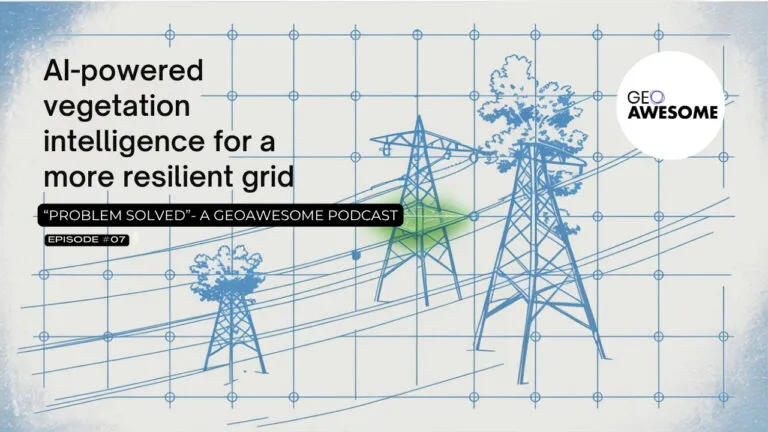
AI-powered vegetation intelligence for a more resilient grid | Problem Solved | Geoawesome
Wildfires, storms, and overgrown vegetation threaten the reliability of our power grids. In this episode of Problem Solved by Geoawesome, experts from Vantor, UP42, and Overstory discuss how AI-powered vegetation intelligence and satellite data are transforming grid resilience—helping utilities predict and prevent outages before they happen.
Search
