
Bentley Systems’ promotion of Andy Rahden to chief revenue officer could be dismissed as a routine executive appointment. Seen alongside Bentley’s AI architecture and its latest financial disclosures, however, it points to a more interesting strategy: selling engineering AI will require hands-on implementation, organized customer data and a much tighter connection between product teams and infrastructure practitioners.
Rahden succeeds Brock Ballard after serving as Bentley’s senior vice president of Solution Engineering and Services. He joined the company in 2023 and previously held technical and commercial leadership positions at Autodesk and Pluralsight.
In Bentley’s appointment announcement, CEO Nicholas Cumins explicitly linked the decision to AI adoption. He argued that helping infrastructure organizations use AI requires deeper account knowledge and faster transmission of customer feedback to product teams.
That framing matters. Rahden has been responsible for Bentley’s application engineers, solution architects, consultants and technical account managers, the people who help customers make complex software work with real engineering data.
In a June interview with DailyCADCAM, Rahden identified disorganized data as one of the largest barriers to engineering AI. Many organizations cannot reliably locate previous drawings, analyses, files or references, making even capable AI systems difficult to deploy safely.
Bentley’s proposed answer combines ProjectWise-managed engineering data with iTwin, SYNCHRO, AssetWise and deterministic engineering applications. AI assistants can help users search projects, reuse designs, optimize structures, generate drawings or plan work, but the underlying calculations remain connected to specialist engineering tools.
This resembles the shift Geoawesome examined in Agentic GeoAI and the Model Context Protocol: general-purpose assistants become interfaces to trusted domain systems rather than replacements for them.
Bentley told investors that it now has six Model Context Protocol servers across its engineering applications, beginning with STAAD. Customers will be able to connect Bentley tools to assistants including ChatGPT, Claude and Gemini, as well as Bentley’s own Copilot.
Crucially, the company does not expect meaningful AI monetization in 2026. Its current priorities are adoption, experimentation and validation, with monetization expected to begin in 2027. Bentley also acknowledges that conventional per-user licensing may not translate neatly to agents that execute engineering operations at machine speed.
That creates a formidable assignment for the new CRO: establish what customers will pay for, determine whether value belongs in the AI interface or the underlying application, and build commercial metrics for usage that may no longer correspond to human seats.
Bentley enters this transition from a strong financial position. Its second-quarter results reported revenue of $410.7 million, up 12.8% year over year, with subscription revenue representing more than 92% of the total. Annualized recurring revenue reached $1.536 billion, while net revenue retention stood at 109%.
Those figures confirm a healthy subscription business, but they do not yet demonstrate demand for paid AI. Bentley has not disclosed detailed agent-usage metrics, independent productivity benchmarks, AI-specific revenue or enough customer case studies to determine whether the technology is progressing beyond controlled deployments.
There is also a commercial balancing act. Bentley’s most complex infrastructure accounts may need intensive solution engineering and data preparation, while the company simultaneously reports adding more than 600 smaller customers through its Virtuoso business. An enterprise-heavy AI strategy could make adoption expensive unless Bentley can package the technology for smaller engineering organizations.
Public reaction to Rahden’s appointment has so far been overwhelmingly congratulatory rather than analytical. One independent investor analysis raised a related concern: concentrating on sophisticated enterprise deployments could underplay growth opportunities among smaller customers and new geographic markets. That remains a risk to monitor, not evidence that the strategy is failing.
Promoting a solution-engineering leader to CRO suggests Bentley understands that gap. The company is not merely preparing to sell another AI feature. It is reorganizing the path between engineering data, implementation and revenue.



#Business
Next article

The growth of high-resolution SAR constellations is increasing the mismatch between data acquisition capacity and available downlink. More frequent imaging does not automatically translate into faster intelligence if large raw or focused products must wait for a ground contact window and terrestrial processing.
A new research paper examines whether learned compression can be redesigned around the compute and power constraints of an onboard system. Its contribution is not a new state-of-the-art compression model. It is a hardware deployment study that tests what happens when a promising algorithm meets a restricted operator set, fixed-point arithmetic and limited energy.
Combining compression and despeckling
SAR compression presents a distinct problem from compression of optical imagery. Speckle is inherent to coherent radar imaging, and a neural codec may spend part of its limited representation capacity encoding that variation rather than the underlying scene.
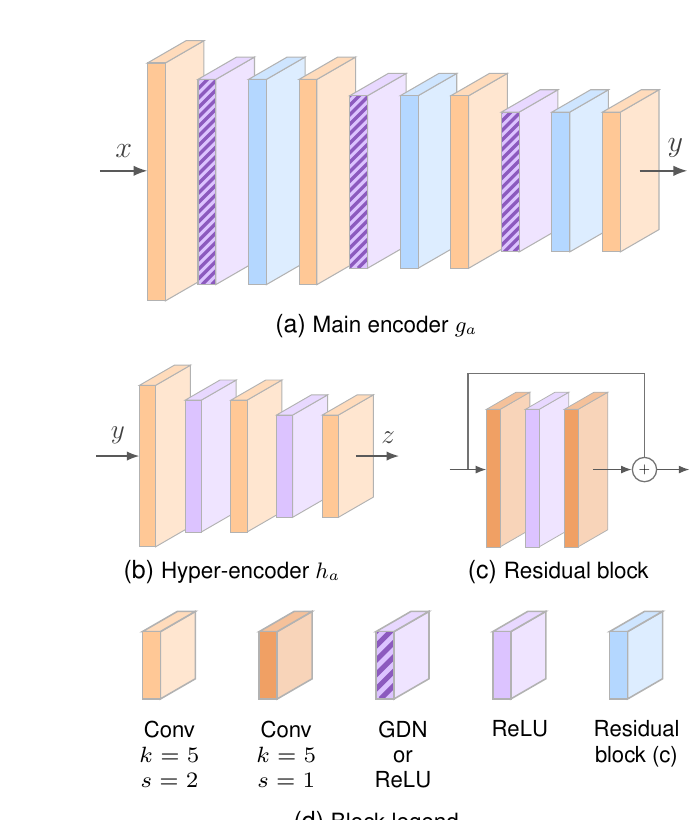
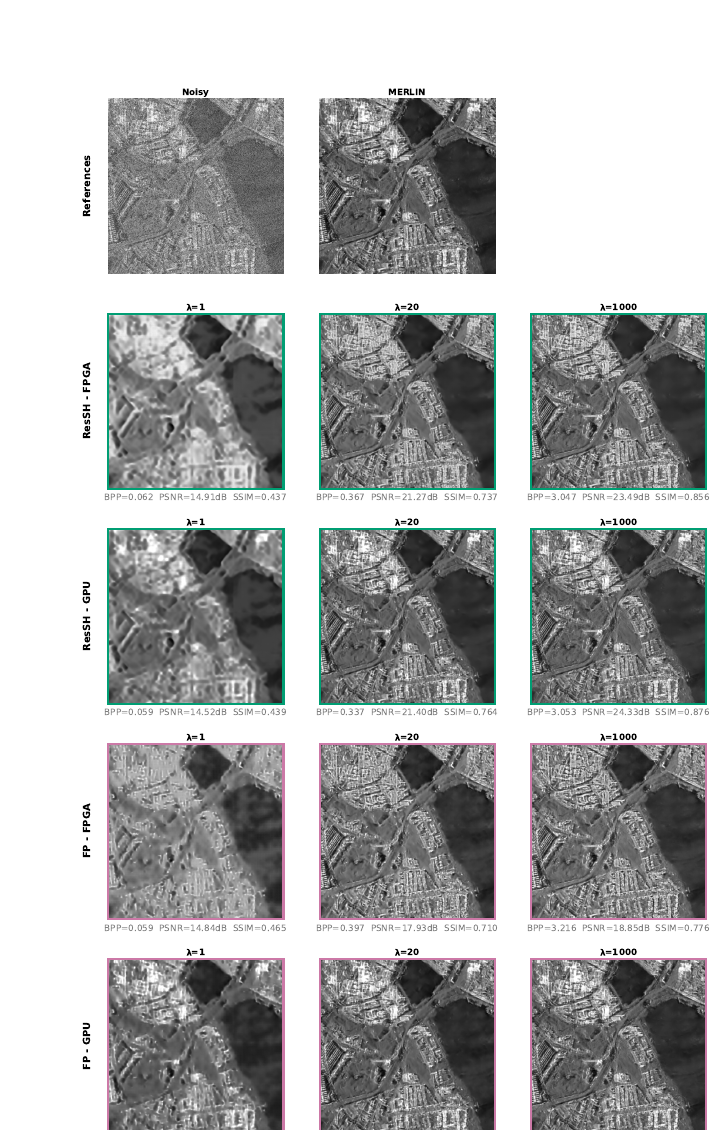
The researchers therefore used a joint despeckling and data-compression framework. It learns a compact representation of a focused single-look complex image while reconstructing a despeckled output. The model was trained using approximately 35,000 patches derived from five TerraSAR-X StripMap scenes.
The team adapted four model configurations to an AMD ZCU102 development board with a field-programmable gate array. FPGAs are already common in space payloads because they combine low-power parallel processing with reconfigurability and can be implemented in radiation-tolerant systems. ESA identifies FPGA parallelism as one route to handling instrument data volumes that exceed downlink capacity.
The hardware constraints produced a useful result: simpler architectures performed well. Replacing generalized divisive normalization with ReLU improved the reported rate-distortion performance on SAR data. Residual blocks increased the computational workload by roughly an order of magnitude while providing little representational benefit.
The broader lesson is that architectures optimized for natural images should not be transferred to SAR without reconsidering both the signal characteristics and deployment environment.
Potential downlink savings
The FPGA was the most energy-efficient of the CPU, GPU and FPGA platforms tested, although it was not always the fastest. The authors also projected performance for a complete TerraSAR-X tile containing 11,000 overlapping patches.
In that projection, the lightest model would process the tile in about four minutes and consume 2.36 kJ. A 2.51 GB input could be reduced to approximately 123–132 MB at the highest tested bitrate, or 12.7–14.2 MB near the selected rate-distortion trade-off.
These figures indicate one to two orders of magnitude less data for transmission. They are extrapolations, however, and do not fully account for memory limits, scheduling or transfers between processor components.
Not yet a flight-ready pipeline
The study operates on focused SAR products rather than raw echoes. A satellite using the method would first need to perform SAR focusing onboard, which is itself computationally demanding. The ZCU102 is also a prototyping platform, not a flight-qualified implementation.
More importantly, despeckling is not neutral for every application. Speckle carries statistical information, and mission operators would need task-specific validation to establish what can be removed without weakening scientific measurements, interferometric workflows or target analysis.
The authors present the work as exploratory groundwork, and that is the appropriate interpretation. It demonstrates that learned SAR compression can be reshaped for embedded execution without automatically losing its advantage. It does not demonstrate an operational spacecraft system.
The next step could be more consequential than compression alone. A compact onboard representation could support detection or segmentation without first reconstructing the full image. That would move SAR missions from onboard data reduction toward onboard exploitation—prioritizing alerts or products before the next ground contact.
For constellation operators, the strategic question is no longer simply how much imagery a satellite can collect. It is how much useful information the mission can deliver within its communications and power budget.
How do you like this article? Read more and subscribe to our monthly newsletter!