Applications Are Now Open for ClimateLaunchpad 2026: World’s Largest Green Business Ideas Competition

Got a climate idea? Now’s your chance.
ClimateLaunchpad, the world’s largest green business ideas competition run by Climate KIC, has officially opened applications for its 2026 edition. Since its launch in 2014, the programme has supported nearly 5,000 ideas across 97 countries. And this year, the event will be bigger than ever.
The 2026 Global Grand Final will be hosted in Singapore, marking a focused expansion of ClimateLaunchpad’s presence in the Asia-Pacific region and convening climate innovators from 50+ countries on a global stage.
A clear path from idea to impact
The program is designed for people who are just starting their businesses. You don’t need a company, money, or a finished product to participate. Participants go through a step-by-step process. First, they take an online course about climate basics and entrepreneurial thinking. Then, they attend an intensive Boot Camp led by expert trainers. After that, they get coaching to improve their pitches and value propositions. The top teams move on to the national and regional finals, where they compete for a spot at the Global Grand Final.
Winners get cash prizes, investor connections, and access to a global clean energy network.
Is it geospatial-focused?
Many of the most interesting ideas for dealing with climate change depend on satellite data, GIS analysis, and location intelligence. Entrepreneurs who use these tools when entering ClimateLaunchpad can gain a significant advantage in addressing the climate crisis on a large scale.
Ready to apply for the competition?
The applications are free, you don’t have to give up any equity, and you can keep full ownership of your idea. If you’re interested in clean energy, food systems, circular economies, or sustainable mobility, you can find a place for your idea here.
Apply now at climatelaunchpad.com – deadlines vary by country, so don’t wait!
How do you like this article? Read more and subscribe to our monthly newsletter!


#Environment

Next article
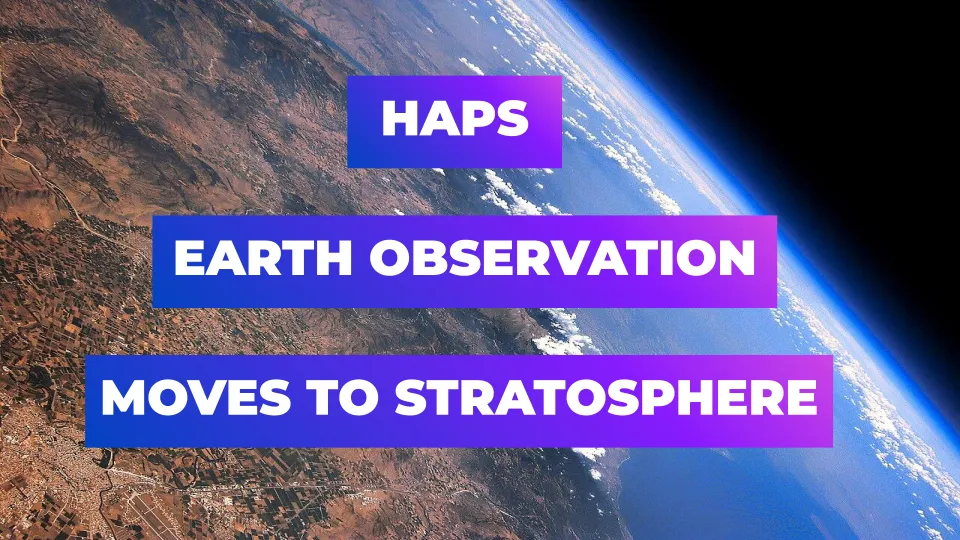

High-Altitude Platform Stations, commonly known as HAPS, are unmanned aerial platforms operating high above our heads in the stratosphere, typically at altitudes of 16 to 24 kilometers above Earth’s surface. Positioned between drones and satellites, HAPS offer a unique vantage point that makes them ideal for services such as internet connectivity, navigation, and Earth observation.
The HAPS technology is not entirely new. One of the earliest examples dates back several decades: Boeing’s Condor, a remarkable 60-meter-long reconnaissance aircraft capable of staying airborne for up to 80 hours.
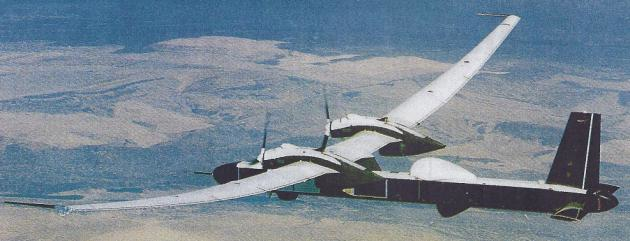
Boeing Condor UAV, Eric Theunissen (2012)
Today’s HAPS platforms have evolved far beyond. Thanks to advances in electric propulsion, solar energy, and lightweight materials like carbon-fiber or UV-resistant solar arrays, some modern systems can now remain in continuous flight for even 3 years. On December, 23rd, the Aerostar company announced that their balloon – Theanderhead has been staying aloft for 1096 days. This multipurpose mission have encompassed a diverse range of objectives for NASA and U.S. Department of Defense.
This dramatic increase in endurance positions HAPS as a compelling alternative to low-Earth-orbit satellites – offering greater flexibility, lower deployment costs, and easier maintenance.
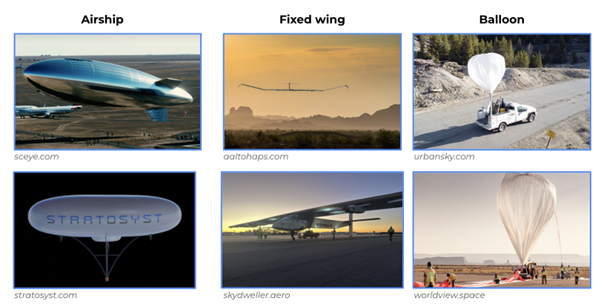
HAPS come in a variety of forms, each designed to meet different operational needs. These include unmanned fixed-wing aircraft, airships, and stratospheric balloons, each with its own strengths, whether it is precise station-keeping, long-term stability, or the ability to carry diverse payloads.
- Fixed-wing HAPS offer precise positioning, higher payload capacity (tens of kilograms), and greater power (hundreds of watts), enabling complex applications for several months.
- Airships can carry the largest payloads (up to 500 kg) and operate for up to a year, though their size increases operational complexity.
- Balloons are lightweight and simple to deploy but have limited power, payload, and positional control.
Filling the gap between drones and satellites
As these platforms continue to mature, HAPS are increasingly filling the gap between drones and satellites in the connectivity and Earth Observation sector, opening a new chapter in the future of monitoring, surveillance, or disaster management applications.
HAPS bridge the gap between the global coverage of satellites and the local precision of lower-altitude platforms.
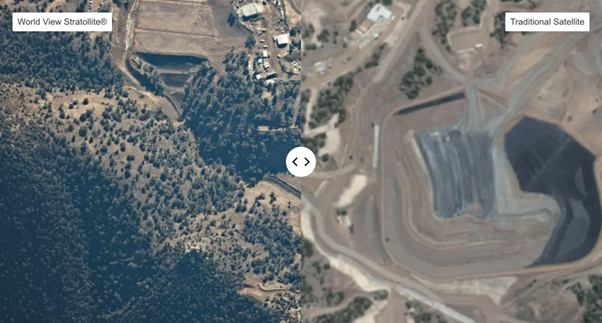
In this layered network, Low Earth Orbit (LEO) satellites deliver continuous data. When more detailed or persistent coverage is needed, HAPS can be quickly deployed and repositioned – often within 24 to 48 hours – to provide long-duration, extremely high resolution (Figure 1) real-time observation.
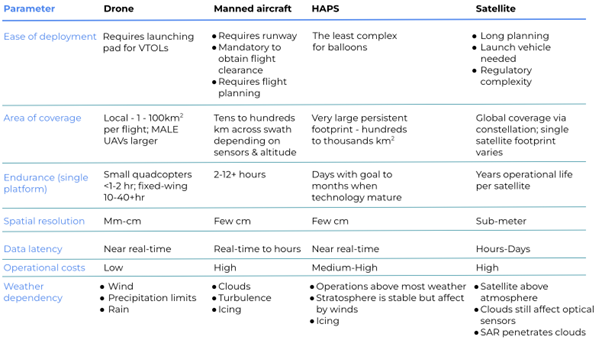
Closer to the ground, drones capture quickly fine-scale, high-resolution imagery or provide local situational awareness, while manned aircraft provide real-time coordination services. Table 1 compares the main parameters of these four complementary data sources.
Table 1. Characteristics of different observation platforms.
HAPS vs satellite image.
worldview.space/remote-sensing
A market ready for takeoff
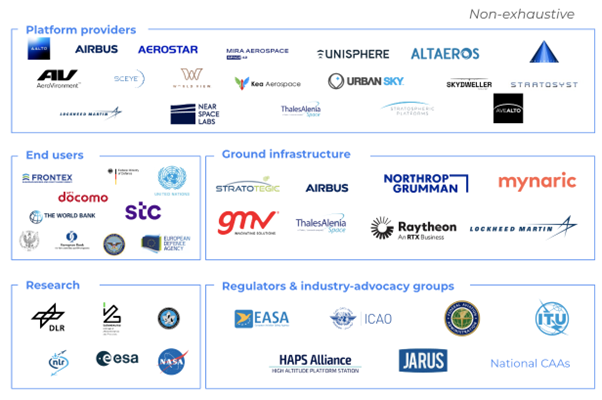
HAPS market is getting crowded – and fast. What used to be a niche area dominated by a handful of aerospace giants has now become a lively mix of established players, new entrants, and cross-industry collaborations. Broadly speaking, there are two main groups of HAPS providers. On one side are the big aerospace and defense companies – names like Airbus (with its subsidiary AALTO HAPS), Thales Alenia Space, Lockheed Martin, and Northrop Grumman – that have expanded their traditional aviation and space portfolios to include stratospheric platforms. On the other side are the new tech-focused startups such as Sceye, World View, Urban Sky, or Mira Aerospace, just to mention few, which are building their entire business models around high-altitude operations.
While many platforms remain in advanced testing and pilot phases, market analysts project that the global HAPS ecosystem could generate approximately EUR 3.5 billion in cumulative value by 2029.
North America, Europe and part of Asia are expected to emerge as one of the leading HAPS deployment regions. Forecasts indicate that up to 1,000 HAPS platforms could be deployed annually in Europe by the end of the decade.
The market expansion is primarily driven by the growing demand for cost-efficient, resilient, and rapidly deployable connectivity and Earth Observation services, particularly in remote, rural, and infrastructure-poor regions. Table 2 provide examples of selected use cases.
| Sector | Connectivity | Earth Observation |
| Disaster Management | Network in disaster-hit areas. | Monitoring of natural disaster evolution (floods, fires, earthquakes) . |
| Safety and Security | Long-range communication for law enforcement. | Persistent surveillance e.g. along borders or large public events. |
| Maritime Awareness | Broadband connectivity to vessels. | Monitor vessel activity, detect illegal fishing, and track oil spills or pollution. |
| Insurance | Support real-time data exchange in remote or disaster-affected regions. | Precise damage evaluation. |
| Transportation | Broadband for intelligent transport systems and connected or autonomous vehicles. | Monitoring of traffic flow, infrastructure conditions, and environmental impacts from above. |
| Agriculture | Persistent rural broadband to connect farms and smart IoT devices. | Crop health, soil moisture, and pest activity monitoring. |
Table 2. Selected use case for connectivity, EO and navigation applications in various sectors.
Major telecommunications operators are increasingly recognises HAPS as the part of their network architectures that complement satellites and terrestrial systems. Recent examples include the 2023 Memorandum of Understanding between AALTO HAPS and Saudi Arabia’s stc Group, aimed at expanding stratospheric connectivity over unserved areas, followed by a similar strategic partnership signed in 2024 with Indonesia’s Mitratel.
At the same time, sustained innovation across aeronautics, advanced materials, energy storage, and data transmission technologies is accelerating HAPS scalability and commercial readiness. Breakthroughs in high-efficiency solar cells, hydrogen fuel cells, payload miniaturisation, and thermal management are making long-endurance stratospheric operations increasingly feasible, sustainable, and cost-effective. Together, these developments position HAPS as a critical enabling layer in the future Earth Observation and connectivity ecosystem.
Governments and private investors are increasingly turning their attention to stratospheric connectivity and observation platforms as a promising extension of the Earth Observation ecosystem. In the United Kingdom, the UK Space Agency has recently committed £20 million (USD 26.1 million) to support a new wave of aerial connectivity projects. The initiative is intended to speed up the development of next-generation telecommunications systems, especially those based on drones and high-altitude platforms that can deliver wireless coverage to regions where ground infrastructure is limited or entirely absent.⁷
Momentum is building in the United States as well. Swift Engineering has received a Phase II award from NASA’s Small Business Innovation Research (SBIR) programme to further develop its Swift Ultra Long Endurance (SULE) platform.⁸ The goal is to demonstrate ultra-efficient, long-duration flight in the stratosphere, paving the way for both commercial and government uses, including persistent Earth observation, communications, and environmental monitoring.
At the same time, private investment is flowing steadily into the sector, reflecting growing confidence in the commercial viability of stratospheric systems. In June 2024, fixed-wing HAPS operator AALTO HAPS secured a USD 100 million funding round, led by a Japanese consortium that includes NTT DOCOMO and Space Compass. Another US-based company, Urban Sky, raised USD 30 million in Series B funding to expand its fleet of reusable stratospheric balloons, designed for imaging and connectivity services.
Alternative platform concepts are also attracting attention. Sceye is developing a stratospheric airship aimed at providing internet connectivity alongside remote sensing capabilities. The company raised USD 50 million in a Series B round in 2021, followed by a Series C round that increased its pre-money valuation to USD 525 million, underlining investor interest in long-endurance stratospheric solutions.⁹ ¹⁰
Stratospheric platforms are gaining particular traction in the defence and security domain. Skydweller Aero, a US–Spanish startup, has attracted investment from major industry players including Leonardo and Palantir Technologies. The company is developing a large, solar-powered, autonomous HAPS aircraft capable of sustained, long-duration flight. Through its partnership with Palantir, Skydweller is integrating advanced target-recognition and data-analysis capabilities for defence applications, and has already secured a USD 5 million contract with the US Navy to continue platform development. To date, the company has raised USD 40 million in venture capital funding.¹¹
Many of these entities are teaming up with telecom operators, sensor manufacturers, and data analytics firms to deliver end-to-end solutions.
Supporting this ecosystem are research institutes, regulators, and advocacy groups like NASA, ESA, EASA, ICAO, and the HAPS Alliance. They’re setting the standards, testing new technologies, and helping shape the rules that will guide safe and scalable HAPS operations. Their work is especially important as companies look to integrate these platforms into regulated airspace and global communication networks.
For now, high technical barriers in areas like aerodynamics, energy storage, and stratospheric weather modeling keep the field from becoming too crowded. But as technology improves and commercial pilots expand, the HAPS market is starting to feel a lot like the early days of the satellite or drone industry — full of promise, collaboration, and healthy competition.
Bibliography
- https://aerostar.com/news#:~:text=Aerostar:%20Three%20Years.,the%20world%20every%20single%20day.
- https://www.esa.int/About_Us/50_years_of_ESA/50_years_of_Earth_Observation
- https://www.eoportal.org/satellite-missions/landsat-1-3#summary
- https://space-solutions.airbus.com/imagery/our-optical-and-radar-satellite-imagery/pleiades-neo/
- https://www.frontex.europa.eu/assets/EUresearchprojects/2023/FX_HAPS_WP1_-_Market_Report_V4.pdf
- https://elib.dlr.de/200789/1/Towards%20the%20Integration%20of%20Higher%20Airspace%20Operations%20in%20the%20European%20ATM%20Network.pdf
- https://www.futuremarketinsights.com/reports/high-altitude-pseudo-satellite-market
- https://www.datacenterdynamics.com/en/news/uk-space-agency-announces-20m-funding-for-aerial-connectivity-projects/#:~:text=It%20will%20improve%20our%20health,Josef%20Aschbacher%2C%20ESA%20Director%20General
- https://uasmagazine.com/articles/nasa-awards-phase-ii-sbir-to-swift-engineering-for-high-altitude-uas
- https://www.telecomreviewamericas.com/articles/satellite-and-broadcasting/from-latin-america-to-saudi-sceyes-haps-funding-secured/
- https://raindefense.ai/2022/06/startups-enter-the-stratosphere-as-haps-market-grows/
- https://raindefense.ai/2022/06/startups-enter-the-stratosphere-as-haps-market-grows/
- https://www.polarismarketresearch.com/industry-analysis/high-altitude-platforms-market